Who is watching the AI agent? A new approach to protecting company data
In the first wave of enterprise AI, the main question was what data an employee pasted into a chatbot's text box. The next stage is considerably more complex. Autonomous or semi-autonomous AI agents no longer just answer questions: they open files, query databases, launch programs, connect to external services and carry out tasks that take several steps.
That is extremely useful, but it raises a new security question: how can you establish exactly which company information the AI accessed, what it did with it, and where the content it produced ended up?
How is an AI agent different from a chatbot?
With a traditional generative AI service, the user starts each step: they ask a question, perhaps upload a document, get the answer and decide what to do with it. There is almost always a human checkpoint.
An AI agent, by contrast, is given a goal. It plans the intermediate steps itself: it chooses from the tools available to it, reads and writes files, makes API calls, queries databases or works together with other agents.
Take a simple example. The agent's task is to prepare a management summary of a security incident. To do so, it can open the event logs, the access control records, the related emails, the data of the employees involved and the events from the camera system.
Behind the scenes, several sensitive systems and data sources are being connected, so the security team needs more than the fact that someone "used AI". It needs to know:
- which AI application or agent ran;
- who or which system started it;
- which files, databases and services it accessed;
- which actions it carried out;
- what new content it produced;
- where it stored the result, or to whom it sent it.
A simple application log rarely answers all of these questions.
A trusted employee's access at machine speed
AI agents often do not work with separate permissions of their own; they use the access of a user or a service account. Whatever the employee can open or query, the agent they start can reach as well.
Cyberhaven's CEO, Nishant Doshi, put it this way: AI agents now work with the access of a trusted employee. He added that at many companies the first data incident of this kind will probably not be an attack, but an agent doing exactly what it was asked to do, only with data it should never have touched.
This makes the AI agent a new kind of insider. It is not necessarily malicious, and no external attack is needed: the risk can come from a legitimate task during which the agent uses data it does not actually need. Why an AI focused on a task does not automatically stop at access boundaries is something I discussed in my article on the Anthropic incidents.
The difference lies in scale. A person opens documents by hand, at a limited pace. An agent can review hundreds of files in a short time, combine several sources and create a new, condensed dataset from them. So it is not enough to watch uploads: you also need to see what the AI extracted and what the finished summary or report contains.
What does Cyberhaven's Agentic Data Security promise?
Cyberhaven presented Agentic Data Security (ADS), announced on 5 November 2026, as a new module of its Cyberhaven Flow data security platform. The platform already combined data loss prevention (DLP), insider risk management and data security posture management; ADS extends these capabilities to AI-driven workflows. The vendor says it is available to buy now.
The vendor organises the system around four main capabilities:
| Capability | Vendor claim | Why it matters |
|---|---|---|
| Discovery | Finds AI tools and agents on endpoints, in the cloud and in the browser, including unsanctioned ones, and gives each a risk score. | You can only govern what you know about. |
| Tracing | Records prompts, responses, tool calls, file reads and writes, commands and the data involved. | After an incident, what happened can be rebuilt step by step. |
| Attribution | Ties every action to the person or system behind it; shows people and agents in one view. | "The AI did it" cannot be an explanation. |
| Enforcement | Applies existing data protection policies written for people to agent actions as well: it warns or blocks. | No separate rulebook is needed for AI. |
Discovery is fundamental because approved solutions, browser services, coding assistants and unsanctioned "shadow AI" tools may all run at once. If a department adopts an agent on its own, control over the data can be lost without a single official setting changing. According to the product overview, ADS also monitors tool calls made over MCP.
Tracing matters in an investigation. A single alert that sensitive data touched an AI application says little on its own; you need to see whether the agent only processed the data, transformed it, stored it locally or passed it to an external service.
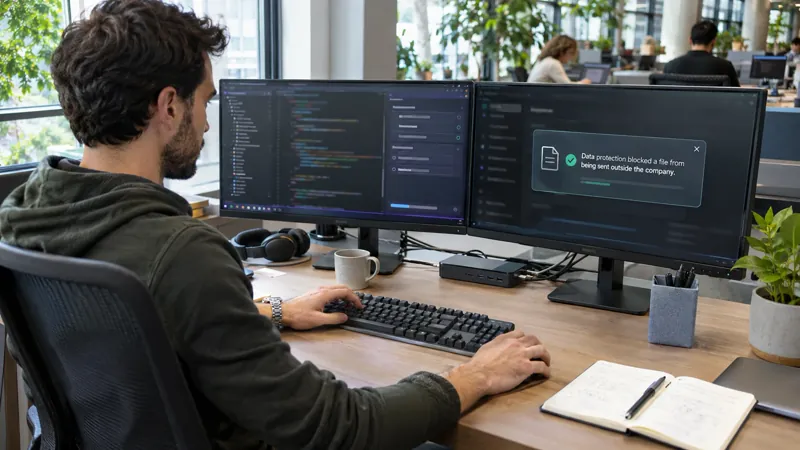
Attribution is the basis of accountability: after an event, you must establish who authorised the access, in whose account the action ran, and where human approval should have been requested.
The point of enforcement is that the same rule applies to the person and to the agent: if a floor plan or a customer list may not be uploaded to an external service, the agent must not be able to do it either.
Tracking the file is not enough: you need the data's lineage
At the heart of Cyberhaven's approach is tracking where data comes from and how it moves, known as data lineage. The aim is to know not only where a file is now, but also where the information originated and how it has been transformed.
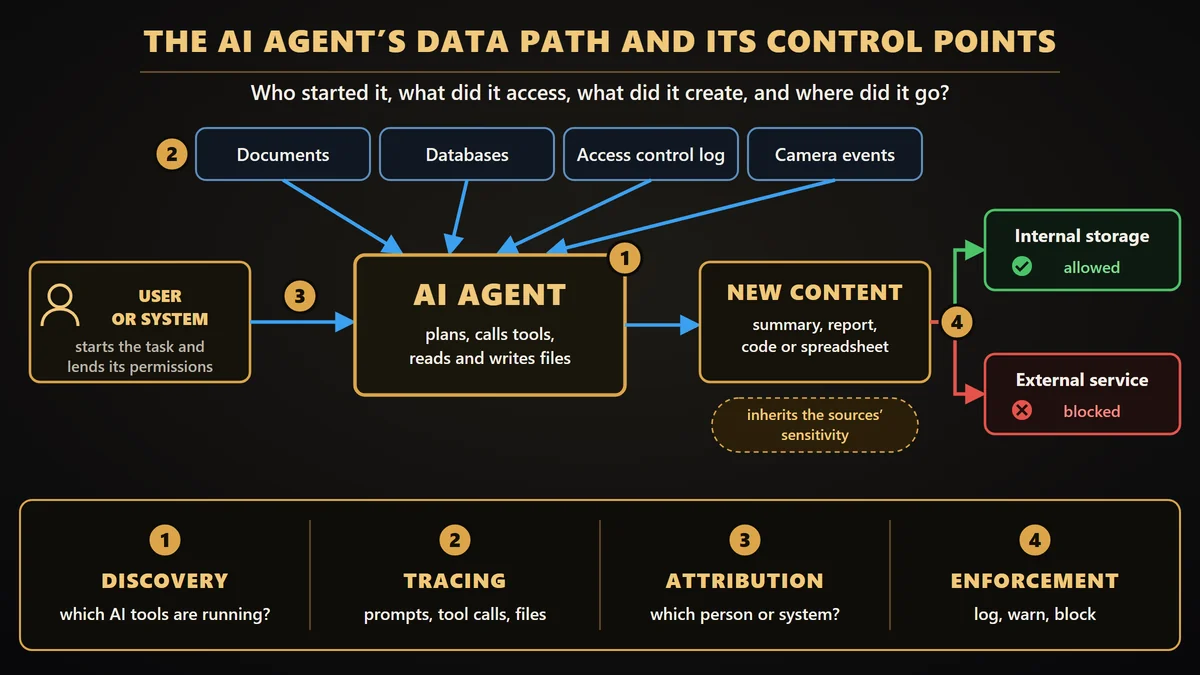
An agent can summarise ten confidential documents in a single new file. Yet their sensitivity labels do not necessarily carry over to it. Technically the summary is a new file; in content, it can be as sensitive as its sources, or more so.
The vendor's product overview describes a typical path: a file travels from cloud storage through the AI application and a tool call into a forecast, which is emailed to a colleague. When the colleague tries to upload the forecast to personal cloud storage, the system stops it, because it knows where the content came from.
A similar situation arises when the AI:
- merges personal data from several databases;
- builds attendance patterns from access control logs;
- summarises event data linked to camera recordings;
- extracts the weak points of a protection system from security design documents;
- finds credentials in source code or configuration files;
- turns a long document into a short report that is easy to forward.
Data security must therefore not lose the context of how sensitive the content is just because the AI has changed its form.
The line between physical and IT security keeps fading
At first sight, agent data security looks like a purely IT matter. Yet much of today's physical security runs in data-driven, networked environments:
- video surveillance systems handle camera images, metadata, licence plates and event information;
- access control systems store data tied to identity, permissions, times and locations;
- visitor management systems keep names, photos, contact details and hosts;
- incident management platforms can link all of this in a shared event record.
An enterprise AI agent might be asked to collect access control anomalies, build the timeline of an incident, assess camera and sensor fault reports or compare maintenance data.
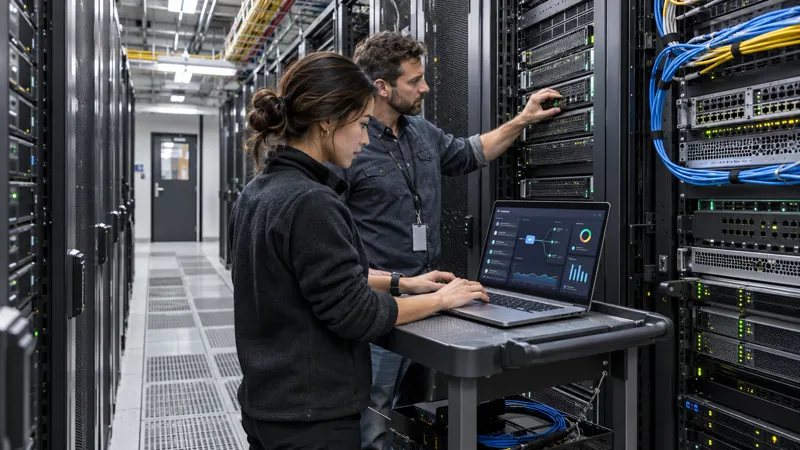
These are useful tasks, but along the way the agent also sees personal data, system drawings and site information. Why the location of the analysis matters in a data centre was the subject of my article on AI-powered video analytics; the secure handling of recordings is covered in this article.
A good pattern is for the AI to be able only to read and analyse at first. In Brivo's access control system, AI arrived as an analyst, not as a door-opening controller: it can read data but cannot change settings. Introducing AI is therefore not just a job for IT: data protection, legal, physical security and operations all need to be involved, as I explained in my article on the convergence of cyber and physical security.
Data leakage is not the only risk
Data leakage is the obvious risk, but not the only one. OWASP's risk list for generative AI treats excessive agency (LLM06:2025) as a separate item, with three root causes:
- too much functionality: the agent can reach tools it does not need for its task;
- too broad permissions: a tool can do more in the back-end system than its purpose requires;
- too much autonomy: a high-impact action runs without independent verification or human approval.
A reporting agent may need to read security events, but hardly to delete records; an email summariser needs read access, not the right to send messages on its own.
The other important risk is prompt injection (LLM01:2025). Here the malicious instruction does not come from the user but hides in a web page, document or email the agent processes; if treated as a command, it can divert the agent from its goal.
How serious the consequences are depends on which data and actions the agent can reach: a system that can only read carries a different risk from one that can send email or modify a database. OWASP itself notes that logging and monitoring do not prevent the problem, they only limit the damage. Watching data movement is therefore an important layer, but it does not replace least privilege, restricted actions, network segmentation and human approval for high-impact steps.
Seven questions before deploying AI agents
It is not enough to decide whether an application is allowed or banned. The whole workflow of the specific use case has to be assessed.
Start from what the specific task requires, not from everything the user can access. Human approval is especially justified before external transfer, deletion, permission changes or changing a security system's settings. And decide how violations are handled in advance, not after the first incident.
Monitoring is itself a data protection question
Recording prompts, responses, file access and tool calls yields valuable security information, but raises a further question: who can see the agent's detailed activity log?
Such a log may contain trade secrets, personal data, internal correspondence, code or incident details, so full visibility must not mean unlimited access. Before deployment, decide:
- which roles may carry out investigations;
- in which cases the detailed content may be opened;
- how the review itself is documented;
- which data minimisation and retention rules apply;
- how monitoring for security purposes is kept separate from unjustified surveillance of employees.
NIST's voluntary AI Risk Management Framework (AI RMF 1.0, 2023) also stresses that AI risk is reduced by governing, mapping, measuring and managing processes together, not by a single product. Technical monitoring only works with clear responsibilities and decision rights.
A product announcement, not independent proof
The Help Net Security article is based on Cyberhaven's announcement, so the features described are vendor claims. They are professionally relevant capabilities, but a public announcement does not replace an independent product test or a pilot in your own environment. Before deployment, it is worth checking:
- which operating systems and AI tools it supports, including command-line tools and local models;
- how it works with encrypted or direct machine-to-machine communication;
- the endpoint load and the false alarm rate;
- how it handles workflows made up of several agents;
- what data it sends to the vendor's own service;
- whether events can be exported for independent verification.
The vendor's figure that endpoint adoption of agentic AI applications doubled in a year, reaching 60 per cent by May 2026, deserves care. It comes from Cyberhaven's own research and telemetry, and the announcement does not say which population it refers to. It is not a statistic for the whole enterprise market, though it does show rapid growth.
The goal is not to stop AI but to make its use verifiable
A general ban on AI agents is hardly a realistic strategy: the tools are already present in development, operations and a growing number of security workflows. The real question is not whether AI may be used, but for which tasks, with which data, with which permissions and under what controls. Where I draw that line in my own work is something I wrote about in my first generative AI article.
Traditional data loss prevention watched how people move files. The new approach also has to see how a partly autonomous digital actor works with the same data. No malicious user is needed for an incident: an overly broad permission, an imprecise task or a manipulated document can be enough.
Data security in the age of agents therefore rests on three questions: who started the action, which data did it touch, and what happened to the information afterwards? Without reliable answers, an organisation cannot see how its AI works, nor the path its own data takes.
Sources: Help Net Security (5 November 2026) · Cyberhaven: press release (5 November 2026) · Cyberhaven: product overview · OWASP: Excessive Agency · OWASP: Prompt Injection · NIST AI RMF
Last reviewed:
Questions, or an idea to talk through?
Whether it is a security system, the IT network behind it or just a thought on this article, I am happy to hear from you.
Get in touch