AI-powered video in data centre security: where should the analytics run?
AI, cloud computing and connected services keep driving demand for computing power, and data centre operators are under pressure to build quickly. In a recent article, John Lutz Boorman, Head of Product and Marketing at Hanwha Vision Europe, notes that cumulative investment in European colocation facilities is forecast to reach €176 billion between 2026 and 2031. Data Centre Solutions – How AI-powered video is reshaping data centre physical security
He argues that physical security must be as much a priority as cybersecurity, and that AI-powered video changes what a camera system does on such a site. A Counterpoint Research analysis published five days earlier asks the question every system designer eventually reaches: where should the AI processing actually happen – on the camera, in a separate box, or split between the two? Counterpoint Research – AI in video surveillance follows multiple routes. Together, the two pieces describe both the task and the architecture. This article connects them, from the fence to the rack.
Why a data centre needs more than recording
On the cyber side, the article cites ENISA, which identifies ransomware as the most impactful cyber threat to the EU. On the physical side, unauthorised access, theft, vandalism and sabotage put people, equipment and business continuity at risk, while wildfires and heatwaves add operational pressure.
The team therefore needs to see not only who enters, but what happens at the perimeter, in the server rooms and across critical areas. How much power and infrastructure sits behind modern AI services is something I explored in When AI inference is measured in megawatts. The more valuable such a site becomes, the less it can rely on footage that someone watches only after the event.
- Perimeter
- Vehicles and gate
- Building entry
- Server hall
- Control room
One VMS, one picture: alerts, search and evidence across every layer
At the fence: from recording to early warning
Traditional CCTV records what happened. According to the article, AI-powered video can also spot unusual activity as it occurs and direct human attention to what needs investigating.
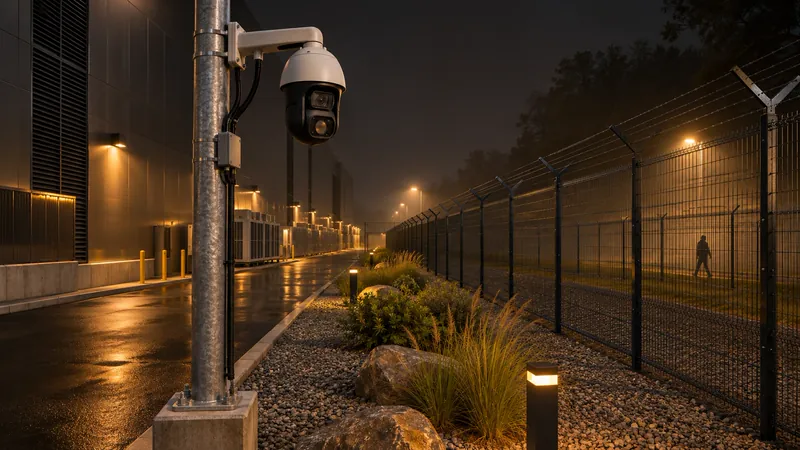
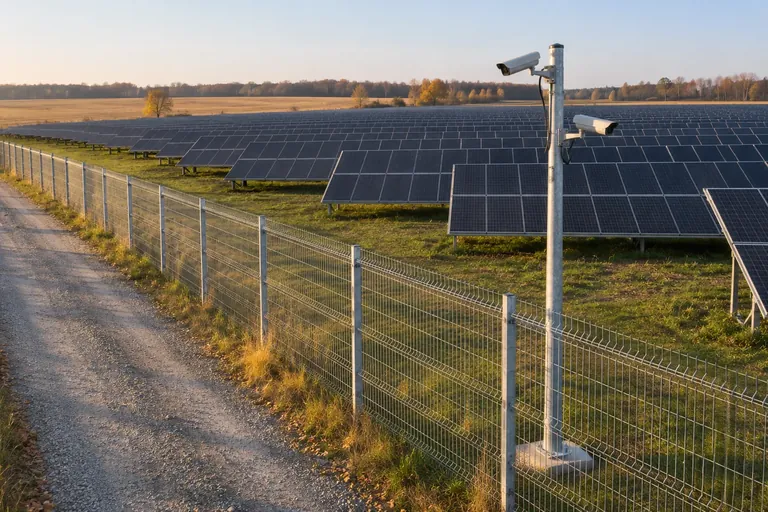
At the perimeter, visual and thermal imaging combined with analytics can help detect movement in darkness, poor visibility or bad weather, and warn early when someone approaches a restricted area. The analytics can also separate significant activity from common sources of false alarms, such as wildlife or moving trees. For vehicles, licence plate recognition can be complemented by type, make, model, colour and direction of travel, so operators can follow a vehicle across cameras: where it came from, where it went and whether it is still on site.
As an engineer, I would add one caveat: fewer false alarms do not come from software alone. Camera position, lighting, background and on-site tuning matter just as much, so the false alarm rate is worth measuring during commissioning, at night and in bad weather too. Where fog limits the camera, another sensor can help, as I described in Radar is not a camera. And an early warning is only worth the response behind it, which is the subject of From alarm to action.
Searching in plain language
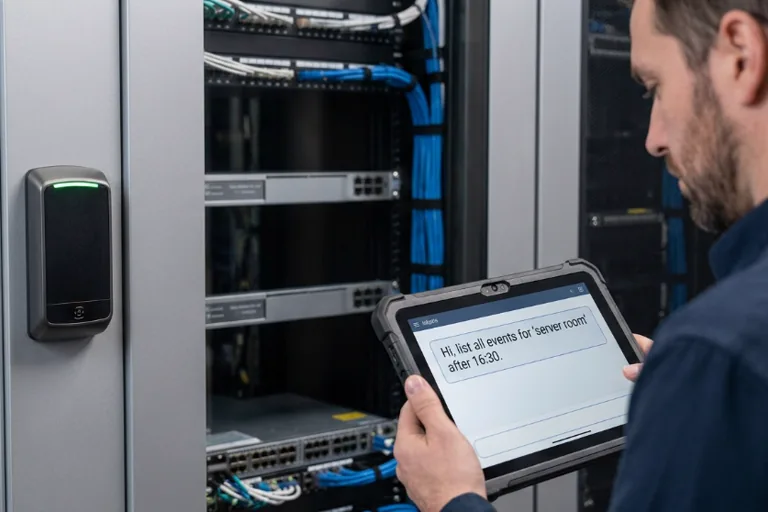
The most visible change is in search. According to the article, some video management systems (VMS) now support semantic search: the operator describes in natural language what they are looking for, instead of picking predefined attributes. The article’s example is “a person carrying a phone”; similarity search can then match sightings of the same person across cameras.
In a data centre, the value comes from combining this with time and place. A query such as “a person at the server hall entrance after 22:00” – my own illustration, not the source’s – could, where supported, turn hours of manual review into minutes. The article is more measured: these capabilities can significantly reduce the time needed to find relevant footage.
Two things should be settled before go-live. A search result is a lead, not proof; its evidentiary value depends on the original recording and its handling, as I explained in From Camera to Courtroom. And tracking people across cameras is processing of personal data: in the EU, purpose, retention, access rights and search logging have to be defined in advance. EDPB Guidelines 3/2019
At the door and the rack: a valid card is not proof
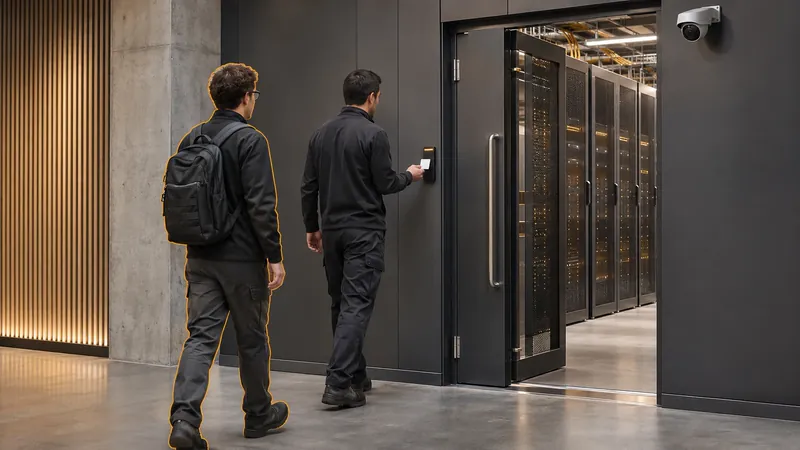
At the building, video adds a layer to access control. A valid credential does not necessarily mean that the person using it is authorised to enter. Video analytics can help identify tailgating, where an unauthorised person follows an authorised one through a controlled entrance, and visual verification can check whether the person matches the credential presented. Two-way audio lets a remote team speak to visitors without someone standing at every door.
Inside, according to the article, AI-powered video can flag people in unexpected places, movement outside normal hours or unusual behaviour around critical equipment – for example, someone lingering near a server rack without reason, even after passing an authorised access point. A central system gives operators a fuller view while an event unfolds, and searchable footage supports the investigation afterwards.
The division of roles is decisive. In my view, analytics should give the operator an alert and context, while the decision to open a door stays with the access control system, as I argued in AI as an analyst, not a door-opening controller. A tailgating alert is useful only if the procedure says who checks it, how quickly, and what follows if it is confirmed.
Where should the AI run? Three architectures
Kalpana Rautela’s Counterpoint analysis assesses three options against four dimensions: where analytics run and what video quality they need, alerting during network or server disruption, fit with existing infrastructure, and scalability across cameras. It also makes a budget point: driven by rising component prices and by hyperscale AI data centres’ demand for memory and chips, the AI video surveillance hardware market is projected to grow from $8.9 billion in 2026 to $24.6 billion in 2030. The irony is hard to miss: the AI boom that makes data centres more valuable also makes the hardware protecting them more expensive.
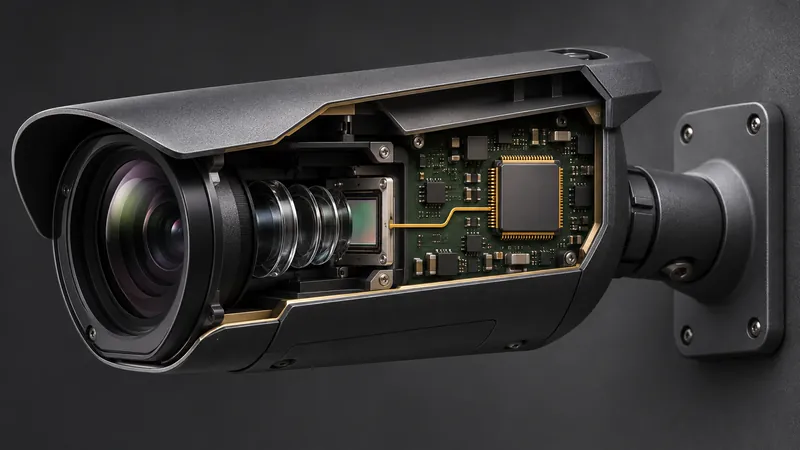
On-camera AI. Processing runs inside the camera on an NPU or edge processor; capability depends on processing power, heat capacity and cost. According to the analysis, Axis has developed its ARTPEC chips for more than 25 years; ARTPEC-9 (2024) delivers three times the analytics performance of earlier generations and supports AV1 encoding, cutting bitrate by 20%. Hanwha Vision’s Wisenet 9 SoC uses two NPUs so that image processing and analytics do not compete. The decision is made locally, so alerts are fast and continue if the connection fails, and the camera can analyse the image before compression. The limit is the single field of view: tracking a person across a site needs more than one camera.
Edge AI box. A separate device on site decodes the streams of existing cameras and runs the analytics centrally. Counterpoint cites Motorola Solutions’ Avigilon appliances, which search for a person or vehicle across a site and support ONVIF-compliant third-party cameras, and Hanwha Vision’s eight-channel AIB-800 built on an NVIDIA Orin NX module. It suits sites where cameras were installed in stages and from different brands, avoiding replacement, recabling and disruption. Its limits are channel count, analytics complexity and processing capacity.
Hybrid AI. According to the analysis, this is not simply a camera plus a box; its value lies in deciding which task runs where. Cameras handle time-sensitive detection and alerts, while the edge device processes several cameras and keeps a shared database.
| Architecture | Strength | Limit | In a data centre |
|---|---|---|---|
| On-camera AI | Low latency, keeps alerting if the network fails, analyses the uncompressed image | One field of view; multi-camera tasks are hard | Perimeter detection, tamper alerts, after-hours alarms at doors |
| Edge AI box | Adds analytics to existing cameras without replacing them | Channels, analytics complexity and capacity per box | Expanded or acquired sites with mixed cameras; site-wide search |
| Hybrid | Fast local response plus capacity and system-wide visibility | Not discussed | Large campuses; the task split must be designed and tested |
Hybrid in practice: dividing the work by task
Counterpoint illustrates the hybrid model with a bank branch: the camera captures a clear image of a person entering, detects loitering in the ATM lobby after hours or flags tampering, while a shared system matches people against a central watchlist and correlates events across cameras. Translated to a data centre – my mapping, not the source’s:
- On the camera: approach to the fence at night, camera tampering, movement in a closed area after hours.
- On the shared system: following a vehicle from the gate to the loading bay, linking a tailgating alert to the access control log.
On an expanding campus, one of the four dimensions – how the system grows when a new hall is built – may decide more than any datasheet. Counterpoint’s conclusion is short: there is no universally best architecture; the choice depends on the workload.
The video system must not become the weak link
The Data Centre Solutions article ends on a point I consider as important as the analytics: the video system can become a target itself. Cyber resilience must therefore be part of the selection, especially as the EU Cyber Resilience Act (CRA) raises the bar for products with digital elements. The article suggests looking for secure-by-design practices and recognised credentials such as the German BSI IT Security Label. I summarised the CRA’s reporting deadlines in Faster cyber attacks in the age of AI.
A camera with an NPU is a computer with its own firmware, models and network interface; why that matters is covered in A Camera Is a Computer Too and The convergence of cyber and physical security. More intelligence at the edge means more devices to update, segment and monitor.
Both sources are worth reading with their origin in mind: the first was written by a manufacturer’s product leader, and the second also uses Hanwha Vision’s products as examples. Product names here are illustrations, not recommendations. The shared message holds regardless of brand: AI helps operators focus on what needs attention and, done well, builds more resilient, layered protection.
Sources: Data Centre Solutions (John Lutz Boorman, 11 November 2026) · Counterpoint Research (Kalpana Rautela, 6 November 2026) · EDPB Guidelines 3/2019 on video devices
Last reviewed:
Questions, or an idea to talk through?
Whether it is a security system, the IT network behind it or just a thought on this article, I am happy to hear from you.
Get in touch