Linux or Windows under the video management system? The case for and against
Which operating system should a video management system (VMS) run on? For years the answer was simply Windows, because most VMS platforms were built for it. Now the question is back. A UK security trade article reports rising demand for Linux-based recording servers and workstations, citing better security, stability and lower cost. Within the same few weeks, Microsoft researchers published the results of an AI-assisted hunt through the Linux kernel: dozens of vulnerabilities, some of them hidden for more than twenty years. Both stories are true, and together they show why the choice is less simple than either camp suggests.
Why the question is back
On 16 October 2026 Security Journal UK published an article built around Video Management Servers Co. (VMS Co.), a British supplier of video management and AI analytics servers. Its managing director, Nick Bowden, argues that Linux is quickly becoming the preferred platform for recording servers, analytics workstations, viewing clients and appliances. The company installs either operating system, so the claim is about what customers ask for rather than what it can sell.
The timing makes sense. Windows 10 reached the end of support in October 2025, so many operator workstations and smaller recording servers had to be migrated or replaced anyway. When a refresh is due, it is natural to ask whether the next platform should be different. AI video analytics has also brought GPU servers into many projects, a field where Linux is widely used.
What the Linux camp claims
According to the article, Linux has four advantages under a VMS:
- Security: user permissions, service isolation, a firewall and a minimal installation give a smaller attack surface. The article goes as far as saying this removes the need for antivirus software.
- Stability: fewer updates, and none of the unplanned automatic updates that can interrupt recording.
- Cost: VMS Co. often uses Ubuntu 24.04 LTS, which carries no licence or upgrade fee, and Linux uses fewer background resources.
- Performance: on identical hardware, the company reports 25 per cent more analytics processing capacity.
The article also admits a drawback: the command line can be a challenge for some technicians, although Bowden says professionals who work with VMS regularly cope with it, and modern Linux desktops already look familiar.
These are statements from a supplier, without published test methods. The 25 per cent figure comes without hardware details, workloads or VMS versions, so it cannot be transferred to another project. That does not make it false, only unproven. The antivirus claim is the one I would challenge most; more on that below.
The other headline: bugs that hid for decades
On 11 November 2026 Microsoft's FORGE Lab published what it had learned from an AI-assisted review of the Linux kernel, and CSO Online reported on it the next day. Using a multi-agent system code-named MDASH, the researchers scanned selected networking, filesystem and security-module code for about two weeks. The funnel is instructive:
- 26,502 raw findings
- 11,769 candidates
- 621 with proof of concept
- 59 public reports
- 33 CVEs
24 of the 33 CVEs are rated High or above (CVSS 7.0 or more)
The bugs were on average 8.1 years old when first reported; the oldest had been in the kernel for at least 21 years. The team built working local privilege-escalation exploits for eight of the CVEs, although some needed non-default settings or disabled mitigations. One flaw sat in rhashtable, a shared hash-table library, and unprivileged users could reach it through netlink socket diagnostics. It worked on standard configurations and affected Android devices too. The fix was a single line.
The researchers' own conclusion is sobering: "Finding bugs and fixing them are drastically out of balance." Scanning took two weeks; turning the findings into validated reports and patches took more than four person-months, and the median time from first public patch to mainline release was 41 days. AI speeds up discovery on both sides, as I wrote in connection with GPT-6 Cyber.
This is not an argument against Linux. Windows receives its own steady flow of kernel and network-stack fixes every month. It is an argument against the idea that any operating system is secure simply because of what it is.
The case for Linux
Read with an engineer's eye, the strongest arguments for Linux are these:
- A minimal installation. A recording server needs no office suite, browser or app store. A server install with only the VMS and its dependencies exposes fewer services, which is a real reduction in attack surface.
- Control over updates. Packages update when the administrator decides, and some distributions offer kernel live patching that applies certain fixes without a reboot. For a recorder that must not stop, that counts.
- Long, predictable support. According to Canonical, Ubuntu 24.04 LTS receives standard security maintenance until May 2029, and with an Ubuntu Pro subscription until May 2034.
- No licence fee for the operating system. Support subscriptions still cost money, but the licence line disappears from the bill of materials, which matters at scale.
- A natural fit for appliances and GPU servers. Many embedded recorders and analytics stacks are already Linux-based, so one platform can cover more of the system.
- Official support from some VMS vendors. Network Optix, for example, lists supported Ubuntu LTS releases for both the Nx Witness server and desktop client.
The case for Windows
The arguments for Windows are less fashionable, but no less concrete:
- Vendor support decides. The system requirements of Milestone XProtect Corporate 2026 R1, one of the most widely deployed platforms, list only Windows 10, Windows 11 and Windows Server 2019 to 2025; Linux is not mentioned for any component. If the VMS does not support Linux for a role, the debate ends there.
- Integrations. Access control, number plate recognition, intercom and PSIM integrations, video wall software and licence dongles are often Windows-only. A system is only as portable as its least portable component.
- Familiar operations. Most integrators' technicians and many clients' IT teams manage Windows with Active Directory, Group Policy and existing patch tools. A Linux server that nobody dares to touch will not be patched either.
- Long-term editions. Windows 11 IoT Enterprise LTSC 2024 is supported until 10 October 2034 and receives security fixes without feature upgrades, which answers much of the "surprise update" complaint. The non-IoT Enterprise LTSC 2024 edition ends in October 2029.
- Mature security tooling. Endpoint protection, application control and central logging for Windows are widely available and familiar to auditors and IT teams.
Side by side
| Aspect | Linux | Windows |
|---|---|---|
| VMS support | Some platforms, e.g. Nx Witness | Practically all major platforms |
| Attack surface | Small with a server-only install | Larger by default, can be reduced |
| Updates | Admin-controlled, live patching possible | Controllable with LTSC and update policies |
| Support period | Ubuntu 24.04: 2029, with Pro 2034 | IoT Enterprise LTSC 2024: 2034 |
| Licence | No OS licence fee | Per device or server |
| Integrations | Check each one | Usually available |
| Skills | Linux administration needed | Widely available |
Three myths worth retiring
"Linux needs no antivirus." Linux malware and ransomware exist. In late October 2025 CISA warned that ransomware groups were exploiting CVE-2024-1086, a Linux kernel privilege-escalation flaw introduced in 2014 and fixed in January 2024. A Linux recorder may not need a classic desktop antivirus, but it does need hardening, integrity monitoring and log collection.
"Windows updates always break recording." Uncontrolled updates do. With LTSC editions, update policies and a test machine, Windows patches can be scheduled into maintenance windows like any other change.
"The platform itself is the risk." In July 2024 a faulty CrowdStrike update took down about 8.5 million Windows devices, without any attack. The lesson is not "avoid Windows", but that every kernel-level component, security agents included, needs staged rollout and a recovery plan, whatever the platform.
The cameras already run Linux
The debate is usually about servers and workstations, yet most IP cameras, encoders and embedded recorders already run embedded Linux. Their security record shows that Linux does not protect a device that ships with old components, open services and default passwords. I explained why a networked camera is a computer in its own right in A camera is a computer too.
The same applies one layer down: in the Zyxel GS1900 case, a switch with the recommended firmware was still exploitable. The operating system is one layer of the system, not the whole of its security.
Decide per role, not per camp
The useful question is not "Linux or Windows?" but "which operating system for which role in this system?" A recording server, a GPU analytics server and an operator workstation have different needs, and the answer can differ between them.
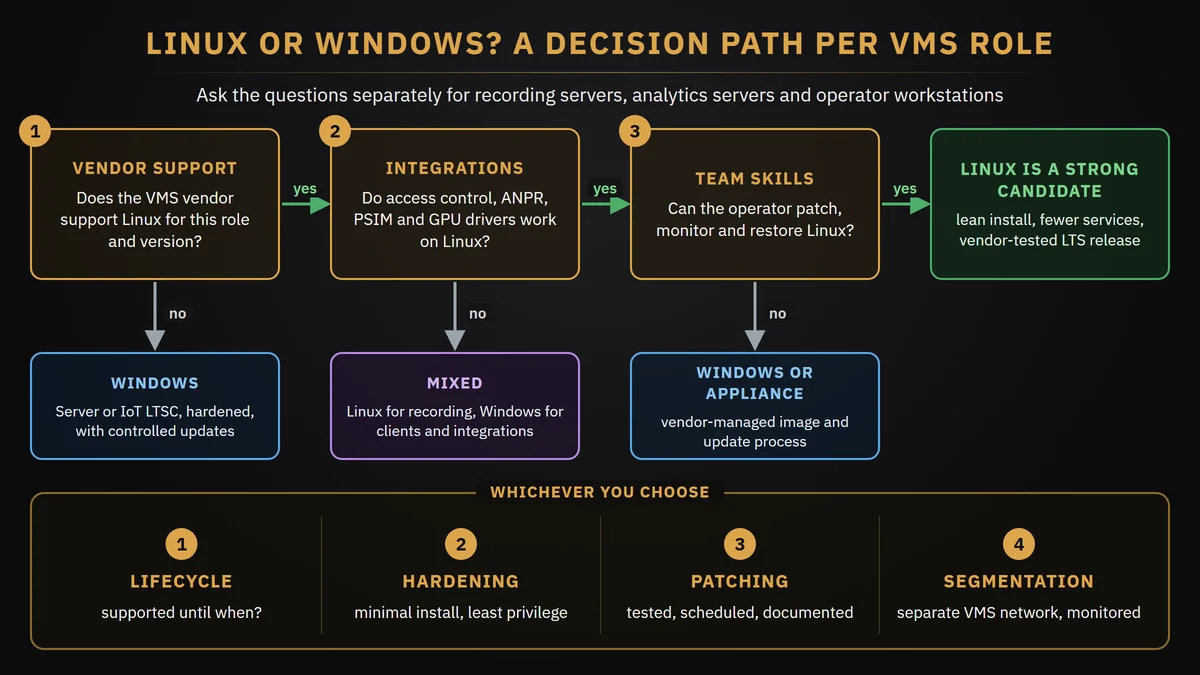
In practice mixed architectures are common: Linux on recording or analytics servers, Windows on operator clients and integration servers. That works, as long as each platform is managed properly rather than half-heartedly. Where the analytics should run in the first place is a separate design decision, which I covered in AI-powered video in data centre security.
What actually makes a VMS secure
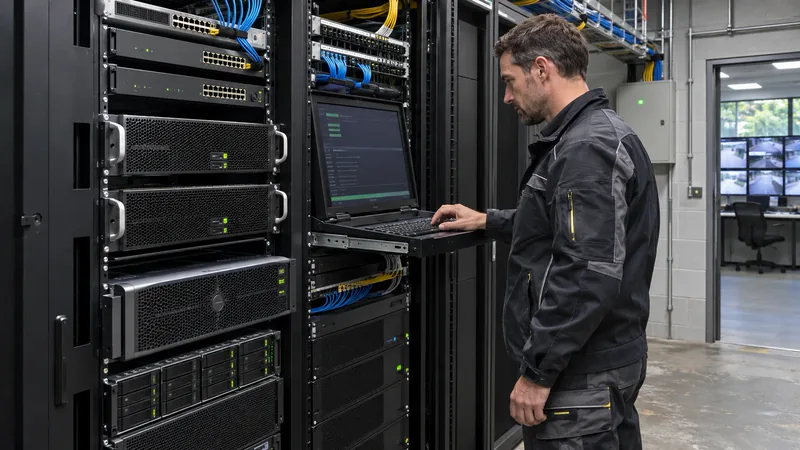
Whichever platform wins, these decide the security of the system:
- Supported lifecycle: the operating system, the VMS and the drivers stay supported for the planned life of the system.
- Hardening: minimal install, no unnecessary services, separate administrator accounts, least privilege.
- Patching: tested on a reference machine, scheduled into maintenance windows, documented and verified afterwards.
- Segmentation: VMS servers in their own network, remote access only through a controlled VPN with multi-factor authentication, no direct internet exposure.
- Monitoring and recovery: logs, health checks, tested configuration backups and a rebuild procedure.
Why responsibility for the network and for physical protection cannot be separated is the theme of The convergence of cyber and physical security. Where the time to patch can be shortened is covered in Faster cyber attacks in the age of AI.
Before you choose: seven questions
The verdict
Linux has real advantages under a VMS: a leaner installation, more control over updates, no licence fee for the operating system and a natural fit for appliances and GPU analytics. Windows has equally real ones: the widest VMS and integration support, long-term LTSC editions and the skills most integrators already have. Microsoft's kernel findings show that neither platform is secure by default; the supplier's claims show that marketing is not measurement.
Choose, role by role, the platform that the VMS vendor supports, that your team can operate and that will be supported for the life of the system. Then spend more effort on hardening, patching and segmentation than on the choice itself. An attacker will not care about the logo on the rack door.
Sources: Security Journal UK (16 October 2026) · CSO Online (12 November 2026) · Microsoft Security Blog (11 November 2026) · Milestone: XProtect Corporate 2026 R1 system requirements · Network Optix: supported operating systems · Canonical: Ubuntu release cycle · Microsoft: products ending support in 2034 · Security Affairs (31 October 2025) · TechCrunch (20 July 2024)
Last reviewed:
Questions, or an idea to talk through?
Whether it is a security system, the IT network behind it or just a thought on this article, I am happy to hear from you.
Get in touch