
The Evidentiary Value of Video Depends on Secure Handling
The primary purpose of a video surveillance (CCTV) system is frequently reduced to a single mechanical task: capturing imagery at an adequate resolution and committing incoming video streams reliably to storage arrays. In reality, capturing the footage is merely the starting line.
The true value of security video is tested when an incident actually occurs. In that critical moment, the footage must be quickly searchable, retrievable, technically intelligible, and above all: legally and securely shareable. Yet in modern physical security systems engineering, this final handover step is far more complex than most stakeholders anticipate.
Video recorded during an incident – whether property damage in a logistics yard, an unauthorized badge passback in an office tower, a workplace accident, or public disorder – inherently contains vast amounts of personally identifiable and sensitive data. When footage must be released to external parties for formal investigations (police, courts), internal disciplinary hearings, insurance claims, or Subject Access Requests (GDPR DSAR), the recording displays innocent bystanders, employee faces, vehicle registration plates, computer monitors, and credential badges alongside the subject under review. Data protection legislation strictly forbids handing over raw, unmodified footage exposing uninvolved individuals.
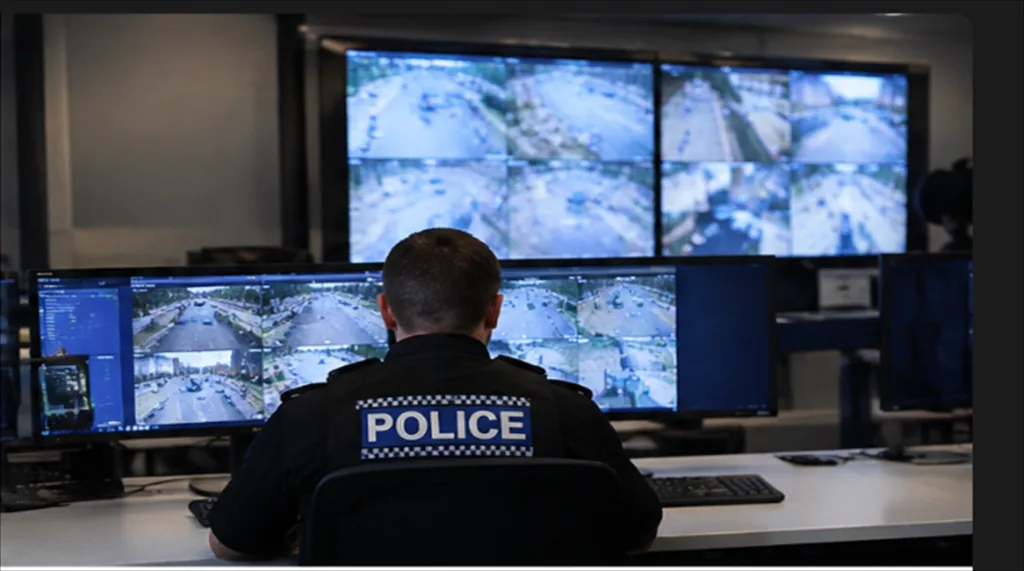
The British Cleveland Police, led by their Digital Services Team, undertook an extensive pilot project examining how artificial intelligence could accelerate the redaction of expanding volumes of digital evidence – including public CCTV, body-worn video, and mobile submissions – while maintaining rigorous human quality assurance, evidential integrity, and an unbroken chain of custody. Operating under the Home Office Audio Visual Multimedia (AVMM) programme, the project deployed PIMLOC’s Secure Redact platform.
The operational metrics were striking: according to the force’s published account, AI-assisted workflows completed redaction tasks 6 to 10 times faster, slashing average per-file processing times by 85 to 90 percent. Individual operators saved 2 to 4 hours per standard case, while complex backlogs that previously dragged on for weeks were resolved in under two working days. For these achievements, Cleveland Police won the prestigious „Excellence in Productivity and Value for Money” award at the NPCC Innovation and Digital Awards 2026, as highlighted in the Police Digital Service (PDS) overview.
What does AI actually do in the video redaction workflow?
Video redaction has historically ranked among the most tedious and resource-intensive obligations in physical security and law enforcement. In a standard 25 frame-per-second (fps) Full HD or 4K surveillance stream, a 10-minute clip encompasses 15,000 discrete frames. When a camera covers a busy logistics yard, transport hub, or corporate lobby where twenty individuals cross paths in multiple directions, an operator manually keyframing blur masks in generic video editing software faces dozens of hours of painstaking work.
This manual bottleneck produced severe operational friction: statutory deadlines under GDPR and disclosure timetables pressed hard, while legal and investigative teams accumulated massive backlogs. AI-assisted redaction directly targets this mechanical drudgery using deep learning and computer vision architectures:
- Object and PII Detection: The system applies convolutional and transformer-based models trained to identify Personally Identifiable Information (PII). This includes human faces, heads, entire figures, vehicle license plates (ANPR/LPR data), lanyard ID badges, and computer display screens showing confidential software.
- Spatio-Temporal Multi-Object Tracking (MOT): Rather than treating frames as disconnected stills, the model establishes temporal coherence. When a detected subject turns away, walks behind a concrete pillar, or shifts through varying illumination, the tracker maintains identity continuity and sustains the bounding box without dropping the mask.
- Dynamic Masking Generation: The engine renders compliant protective overlays – such as Gaussian blurs, pixelation matrices, or solid opaque boxes – non-destructively without altering the underlying master video stream.
- Interactive Review and Editing Workspace: As detailed in PIMLOC’s technical specifications, the core engineering value lies in immediate operator review. With a single click, an investigator can unmask a primary suspect or complainant while leaving all uninvolved third parties securely anonymized.
It is vital to draw a clear technical boundary: the AI does not „understand” an incident like a human detective. It cannot determine guilt, detect fraudulent intent, or gauge evidential weight. It operates strictly as a specialized perceptual filter, eliminating manual repetition so engineering and security professionals can exercise informed judgment.
The hard engineering begins after the camera
During physical security design reviews, discussions inevitably center on hardware: camera resolution, infrared throw distances, optical zoom ratios, RAID resilience, and H.265 compression bandwidth. These are fundamental engineering parameters, but the real test of system architecture arises when video must leave the secure confines of the recorder.
When an incident escalates into formal inquiry, difficult questions emerge immediately: Who holds permission to export raw footage? How is the untouchable evidentiary master file separated from working copies and third-party exports? How can an organization prove in court that an exported video was not tampered with, forged, or edited beyond lawful redaction?
In digital evidence management – an architecture I explored in depth in From camera to courtroom: four points where trust is lost – the foundation rests upon a three-tier lifecycle:
- Original Master Recording: The pristine bitstream recorded straight from the IP camera into write-protected, encrypted VMS storage. It must never be edited, transcoded, or subjected to destructive redaction. It carries cryptographic signatures and watermarks.
- Investigative Working Copy: An exact bit-level export utilized internally by the security team for timeline analysis, forensic review, and AI redaction processing.
- Redacted Disclosure Copy: The audited, anonymized export generated specifically for external release to legal counsel, insurers, regulatory bodies, or subject access applicants.
If an enterprise surveillance deployment treats redaction as an afterthought disconnected from the VMS, rapid processing can inadvertently undermine evidentiary weight. A robust redaction workflow must generate an immutable audit trail documenting which operator executed the export, at what timestamp, across which frames, and under what operational justification.
Human-in-the-loop is not a tick-box formality
An AI-generated redaction mask is never a final verdict; it is an initial proposal. Real-world physical security environments are notoriously hostile to pristine computer vision inference. Automated detectors experience degraded precision under conditions routinely encountered in the field:
- Severe Backlighting and Extreme Dynamic Range: Low morning sunlight streaming through glass atriums, or high-contrast shadows created by warehouse high-bay lighting, can strip facial contours of discriminative contrast.
- Oblique Angles and Partial Occlusions: When subjects pass through full-height turnstiles, interlocking mantrap doors, or security gates, faces are often viewed obliquely or partially obstructed by structural elements.
- High Velocity and Motion Blur: A sprinting intruder or a vehicle accelerating rapidly across a camera’s field of view can slip out of the temporal tracking window across several crucial frames.
- Evidentiary Relevance Confusion: The algorithm cannot understand criminal culpability. In a physical altercation, an automated tool will indiscriminately obscure both the assailant and the victim, rendering the clip useless as primary evidence unless adjusted.
Human oversight is therefore far more than administrative rubber-stamping. The security professional must conduct frame-by-frame verification across critical action sequences: confirming that innocent identities remain obscured, that tracking boxes did not drop during abrupt head turns, and that essential physical evidence – such as a concealed tool or forced door latch – was not mistakenly covered.
Before an arbitral tribunal or criminal court, an algorithm cannot take the witness stand or swear an affidavit. Evidential integrity and procedural compliance remain the sole responsibility of the trained human operator and the system administrator.
Designing for evidence lifecycle, permissions, and auditability
Evidence governance must never be improvised after receiving a regulatory citation or police request; it must be engineered into the system architecture from day one under Privacy by Design (GDPR Article 25). It is insufficient to merely specify camera placement and retention horizons (such as 15, 30, or 60 days).
A resilient physical security design must define clear data management protocols at the specification stage:
- Role-Based Access Control (RBAC): Live camera monitoring, timeline playback, raw clip export, and redaction authoring must be segregated into distinct permission tiers. Standard control room operators should never possess unilateral export privileges; extraction rights belong to designated security managers or Data Protection Officers (DPO).
- The Four-Eyes Principle: In high-security environments – such as financial institutions, pharmaceutical laboratories, or critical infrastructure – video extraction should require mutual cryptographic authorization from two independent supervisors.
- Immutable Audit Logging: The VMS and redaction platform must log every query, stream playback, and export event with microsecond precision. As explored in my article on AI as an analyst, not a door controller, strict auditability and the principle of least privilege become paramount whenever automated tools interface with physical security datasets.
- Cryptographic Hashing and Verification: Exported video packages must automatically include an SHA-256 checksum and digital signature, enabling courts and external auditors to verify that the file remains unaltered since its creation.
AI video redaction provides genuine enterprise value only when integrated directly into this governed export pipeline, rather than existing as an isolated, standalone video tool on an ad-hoc desktop.
Acceleration vs. integrity: the true metric of system design
Cleveland Police’s recorded 85 to 90 percent reduction in processing time is an impressive operational milestone. Nevertheless, numbers achieved within a specialized policing pilot must be interpreted pragmatically when designing commercial, corporate, or industrial security ecosystems. Realized efficiency gains depend heavily upon camera positioning, optical lighting consistency, scene crowd density, and organizational compliance policies.
The decisive engineering question is never simply how many minutes an algorithm shaves off mechanical masking. Speed achieved at the expense of evidential integrity, data privacy, or chain-of-custody documentation is a substantial liability.
A physical security installation proves its worth when recorded data withstands forensic scrutiny, legal dispute, and regulatory audit. Artificial intelligence is an indispensable tool for eliminating cognitive fatigue and manual backlogs – but the responsibility for verifiable evidence and sound engineering design rests squarely with human expertise.
Questions, or an idea to talk through?
Whether it is a security system, the IT network behind it or just a thought on this article, I am happy to hear from you.
Get in touch