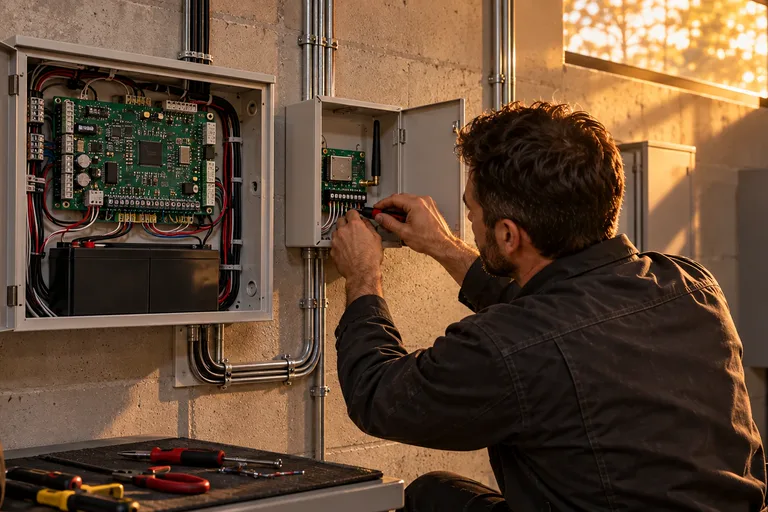
AI as an analyst, not a door-opening controller
The real question is not whether AI can unlock a door.
When an access control system develops a fault, the operator rarely needs yet another dashboard. What they need is a fast, reliable answer.
Which controller is offline? Where are reader errors repeating? Is the issue isolated to a single door, or has the same pattern started across multiple sites? Which fault justifies sending a technician to the site, and which can be resolved remotely?
In most deployments, the answers are already inside the system. They are simply scattered across event logs, controller states, trouble tickets, credential records and customer account data.
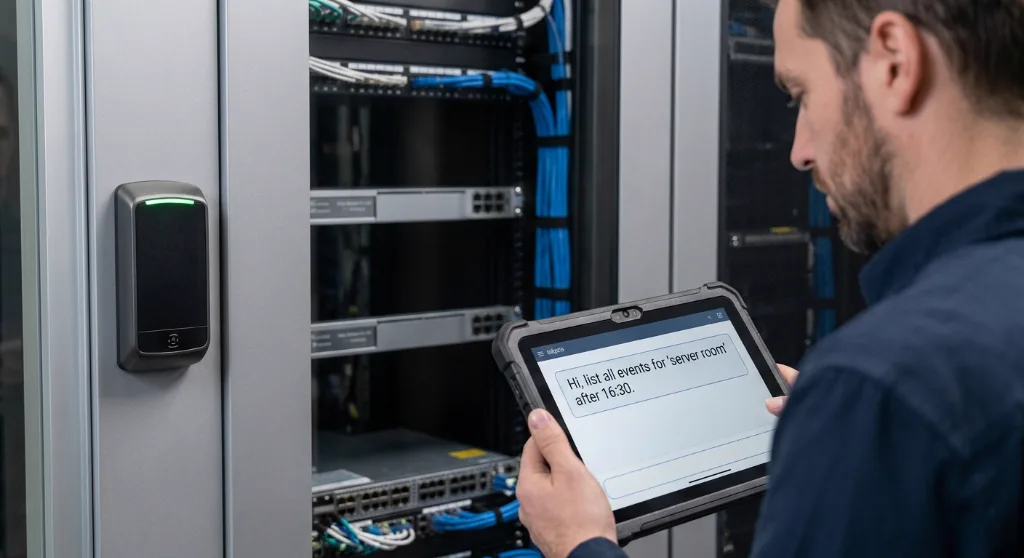
Brivo’s October announcement is noteworthy because it did not introduce a new door controller or a new biometric reader. With its solution called Reseller MCP, it makes selected access control data queryable by AI assistants. An integrator can ask in natural language about offline panels, reader faults, customer accounts or changes in system usage (Security Systems News, October 26, 2026).
The wrong question: can AI intervene on its own?
Artificial intelligence is often discussed today as if its value lay in autonomous action. The fewer human steps involved, the more advanced the solution – or so the promise goes.
In access control, that is a dangerous assumption.
Unlocking a door, modifying access rights or rebooting a controller is not a routine administrative task. It directly affects physical protection, daily operations, access to restricted areas and, in extreme cases, life-safety and fire-evacuation procedures.
That is why it matters that Brivo’s initial AI integration is built strictly on read-only access. The assistant can analyse data, compile lists, look for patterns and draft reports – but it cannot issue control commands, alter settings or lock and unlock doors.
So the right question is not whether AI can open the door.
It is whether AI can spot in time which door, controller or site needs human attention.
The real value: turning scattered data into usable information
In a larger multi-site system, simply piecing together an accurate situational picture can take considerable time.
An AI assistant can help answer practical operational questions such as:
- Which controllers are currently offline, and for how long?
- Which readers show recurring faults or read errors?
- Which customer accounts have seen a significant increase in doors, users or credentials?
- Which recurring faults actually led to on-site service callouts?
- Where is there a gap between the devices recorded in the system and the services billed in the contract?
According to Security Systems News, Brivo also aims to let integrators correlate access control data with CRM, billing and project-management information. For a systems integrator, that matters because a technical fault, a customer request and a service decision rarely live in the same database.
Here, AI does not make the engineering decision. It prepares the ground for the decision.
AI is only as secure as the access it is given
Access control data is never purely technical data. A credential list, an event log or a door-usage pattern reveals a great deal about how an organisation operates and where its sensitive areas are located.
Before connecting an AI assistant to security data, four boundaries have to be defined clearly:
- First: what is the specific purpose? Fault finding, maintenance reporting, account summaries or business analysis? A single well-defined task is far safer to govern than an open-ended “let it see everything” approach.
- Second: what exact data is the assistant allowed to read? Not every operational query requires full event logs, personal names or detailed credential records.
- Third: keep querying strictly separate from control. AI may analyse and summarise, but any change executed in the system must remain the responsibility of an authorised, accountable person – the same lesson highlighted by Anthropic’s autonomous agent incidents.
- Fourth: make every query and every resulting action traceable. If AI flags a fault or an anomaly, the operator must be able to see which data led to that conclusion and who decided on the next step.
A good start is not full automation
The value of a new technology is proven not by a spectacular demo, but by a well-scoped pilot.
It is worth starting with a single practical task: for example, a daily summary of offline controllers, identifying recurring reader faults or preparing monthly customer maintenance reports. From there, you can measure whether fault diagnosis takes less time, whether unnecessary site callouts decrease and how reliable the correlations surfaced by the assistant actually are.
In access control systems, AI is unlikely to arrive in place of the engineer or the operator.
It arrives beside them: helping them spot faster, across a sea of logs and status messages, what genuinely requires human attention.
Source: Security Systems News – Brivo brings security data into AI assistants (October 26, 2026)
Questions, or an idea to talk through?
Whether it is a security system, the IT network behind it or just a thought on this article, I am happy to hear from you.
Get in touch