
A patched switch is not necessarily safe: what the Zyxel GS1900 zero-day teaches security system networks
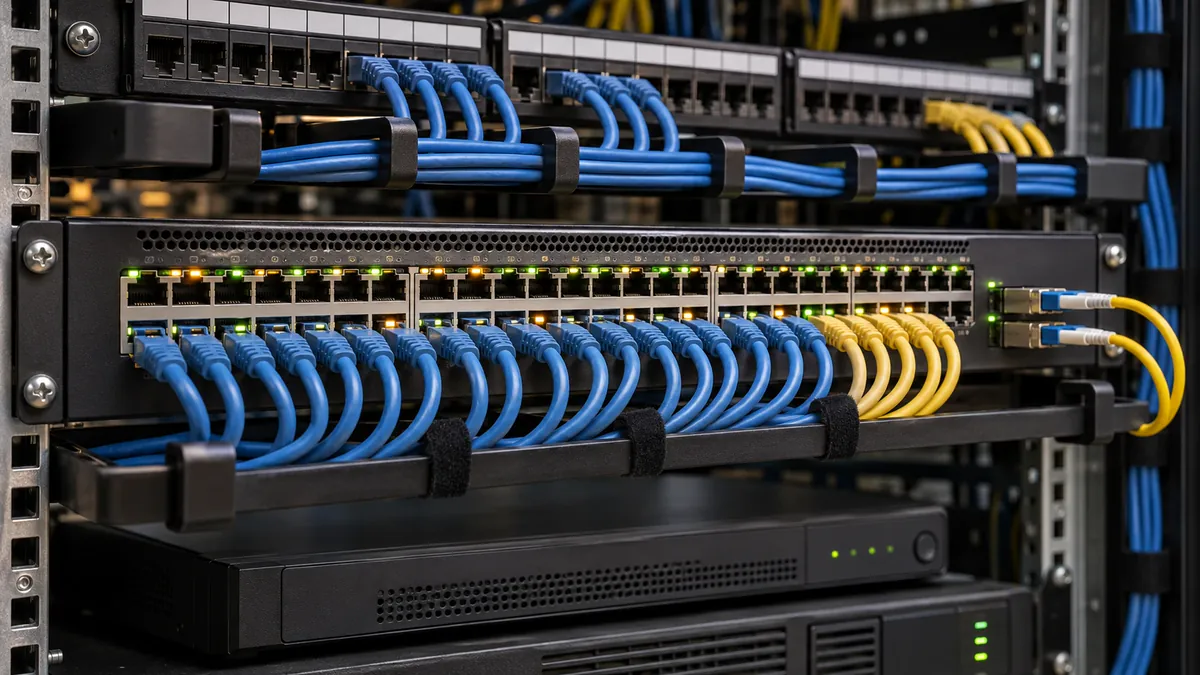
A Zyxel GS1900 switch could remain vulnerable even after the vendor's June security update had been installed. The attackers did not exploit the flaw that the patch addressed, but a different one that nobody had identified yet. This matters especially in security engineering, where cameras, access control systems, alarm transmitters and other critical devices often share the same network infrastructure.
What happened to the Zyxel GS1900 switches?
According to a Help Net Security report from 5 November 2026, members of the Zyxel GS1900 series remained open to attack even after the vendor's June security fix had been applied.
At first glance it looks like a typical "failed update", but technically it needs to be stated more precisely. The June firmware fixed CVE-2026-7273, a stack-based buffer overflow. The exploit the attackers used, however, relied on a different vulnerability, later registered as CVE-2026-107441.
So the June patch did not fix the same bug badly. It fixed another one, while a previously unknown problem stayed in the firmware. At the time of the attacks, the newer vulnerability was therefore a zero-day.
The difference is not just terminology. When an operator sees that the device runs the firmware the vendor recommends, they can reasonably assume it is protected against the known and fixed vulnerability. That does not mean the same software component holds no other, undiscovered flaw. Binarly's researchers confirmed unauthenticated command execution on all ten firmware releases that already contained the June fix.
Two different vulnerabilities
The earlier flaw, CVE-2026-7273, was a stack-based buffer overflow in the CGI program of the GS1900 firmware. Zyxel released the 2.90 Patch 2 firmware versions for it on 16 June 2026.
The newer CVE-2026-107441, by contrast, is an out-of-bounds write. According to Binarly's analysis, the program that processes web interface requests checks neither the length nor the number of parameters, so a crafted request can overwrite a wide range of the process memory. According to the vendor, an unauthenticated attacker with access to the local network can exploit it with a specially crafted HTTP request and execute operating system commands.
Two things follow from this. First, the attacker has to reach the switch's web management interface over the network, so a device that is not connected to the internet is not automatically exposed. Second, no valid username or password is needed: anyone who is already present in the right network segment will not be stopped by the login protection alone.
"LAN-based" exploitability therefore does not mean low risk. An infected maintenance laptop, a poorly separated camera network, an inadequately protected remote access path or another compromised network device can be enough of a starting point.
A campaign that hit almost a thousand devices
According to GreyNoise's investigation, a Chinese-speaking threat actor compromised 996 Zyxel GS1900 switches in 48 countries around 17 August 2026. The attackers obtained configuration data, network information and password hashes for root-level accounts. Telling detail: 564 of the victims were still using factory default credentials.
Early analyses linked the attacks to CVE-2026-7273, and on 21 September the US agency CISA added the flaw to its Known Exploited Vulnerabilities (KEV) catalogue. Meanwhile Binarly found a ready-to-use exploit in an open directory on the attackers' command server and, by 28 September, confirmed that it also worked on patched systems. The researchers believe the exploit code was probably written with the help of a large language model. AI is speeding up vulnerability discovery on both sides; I wrote about this in connection with GPT-6 Cyber.
It cannot be established with full certainty that every one of the nearly thousand devices was breached only through the new vulnerability; old firmware and default passwords may also have played a part. The core finding does not change: the researchers found working attack code that allowed command execution on firmware that was considered patched.
- 16 Jun: Patch 2
- Around 17 Aug: 996 switches breached
- 21 Sep: CISA alert
- 28 Sep: Patch 2 also exploitable
- 22 Oct: Patch 3
Until 22 October, even the June firmware was not protected against the exploit
Why this matters in security engineering
In many installations a switch looks like an invisible background device. It does not record video, read cards or detect intrusion. Yet a large share of a security system's traffic may pass through it. A switch may connect, for example:
- IP cameras to the video management system and the recorders;
- access control panels to the management server;
- IP intercoms and emergency call points;
- the network communicators of alarm systems;
- security workstations, servers and remote monitoring links.
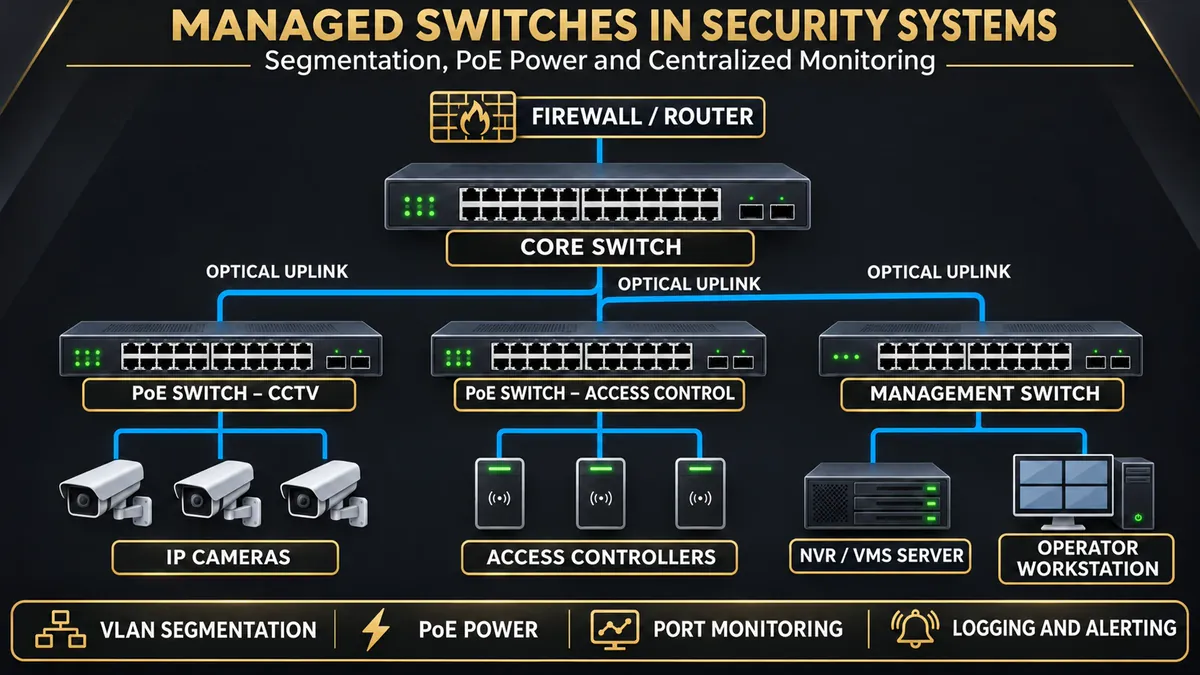
If an attacker can run commands on the switch, the risk does not end with the switch going down. The exact consequences depend on the firmware and the network design, but they may include reading or changing the configuration, shutting down ports, weakening segmentation, preparing traffic interception, or moving laterally towards other systems.
On PoE models, restarting a port or the whole device can also cut power to the connected cameras and intercoms, so the loss of a single switch can blind several cameras at once. I explained why a networked security device is itself a computer in A camera is a computer too.
My own experience: the Hungarian market is directly affected
In my professional experience, Zyxel is one of the most widespread switch brands in Hungarian security engineering. Over my career I have worked with these devices countless times when building camera systems, access control systems and other IP-based security solutions.
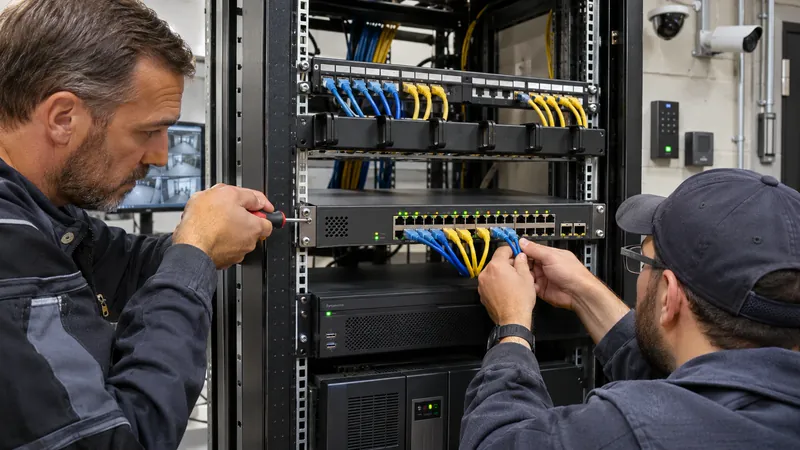
There are several practical reasons for this. The brand's devices have been on the Hungarian market for a long time, they come in a wide range of models, and in many small and medium-sized systems they provide a network foundation with good value for money. The GS1900 series also includes managed models, several of them PoE-capable, that fit the needs of IP camera installations well.
So this is not a distant problem that affects only large corporate IT systems. It is highly relevant to the Hungarian security market as well. Many sites in Hungary, such as premises, shops, offices, residential buildings, schools and industrial facilities, may rely on a Zyxel switch to connect their security devices to the network.
From the practitioner's side it is clear: the presence of the affected devices in Hungary is neither rare nor theoretical.
What a compromised switch can do to a camera system
The most obvious consequence is a loss of availability. If the link between the camera and the recorder breaks, the operator sees no live image and the server receives no video stream to record.
This is not always noticed immediately. In a larger system the operator does not watch every camera all the time, and the video management system only raises an alert if device health monitoring and alarm rules are configured correctly.
The attacker's aim is not necessarily a full shutdown. Intermittently cutting a single port, camera group or uplink is much harder to spot. If this happens at the same time as a physical intrusion, the network event directly weakens the system's ability to produce evidence: what never reaches the recorder cannot enter the chain of evidence either. On PoE models, communication and power are also concentrated in the same device, so a malicious port operation can stop the camera itself.
Access control does not necessarily stop at once
With access control the picture is more nuanced. Many access control panels store permissions locally and make door decisions on their own, so losing the network does not mean every door stops working immediately.
What can break is real-time event forwarding, central monitoring, permission updates, remote door control and integration with camera images. Local operation may continue while the operator can no longer see what is happening, and that can be more dangerous than an outage everyone notices at once. The same applies to IP-based alarm signalling and intercoms.
Which models exactly need checking?
According to Zyxel's advisory of 3 November, CVE-2026-107441 affects ten GS1900 models. Version 2.90 Patch 2 and earlier are vulnerable; the fix is 2.90 Patch 3, released on 22 October. The four-letter code in brackets differs from model to model, so checking for "2.90" alone is not enough.
| Model | Vulnerable (and earlier) | Fixed |
|---|---|---|
| GS1900-8 | 2.90(AAHH.2)C0 | 2.90(AAHH.3)C0 |
| GS1900-8HP | 2.90(AAHI.2)C0 | 2.90(AAHI.3)C0 |
| GS1900-10HP | 2.90(AAZI.2)C0 | 2.90(AAZI.3)C0 |
| GS1900-16 | 2.90(AAHJ.2)C0 | 2.90(AAHJ.3)C0 |
| GS1900-24 | 2.90(AAHL.2)C0 | 2.90(AAHL.3)C0 |
| GS1900-24E | 2.90(AAHK.2)C0 | 2.90(AAHK.3)C0 |
| GS1900-24EP | 2.90(ABTO.2)C0 | 2.90(ABTO.3)C0 |
| GS1900-24HPv2 | 2.90(ABTP.2)C0 | 2.90(ABTP.3)C0 |
| GS1900-48 | 2.90(AAHN.2)C0 | 2.90(AAHN.3)C0 |
| GS1900-48HPv2 | 2.90(ABTQ.2)C0 | 2.90(ABTQ.3)C0 |
Always compare the full firmware identifier and the exact hardware model with the table in Zyxel's official advisory.
What to do now
The first step is not to upload the firmware straight away but to build an accurate device inventory. You need to know where GS1900 switches are in use, their exact model, which firmware they run, what is connected to them, and what outage a restart would cause.
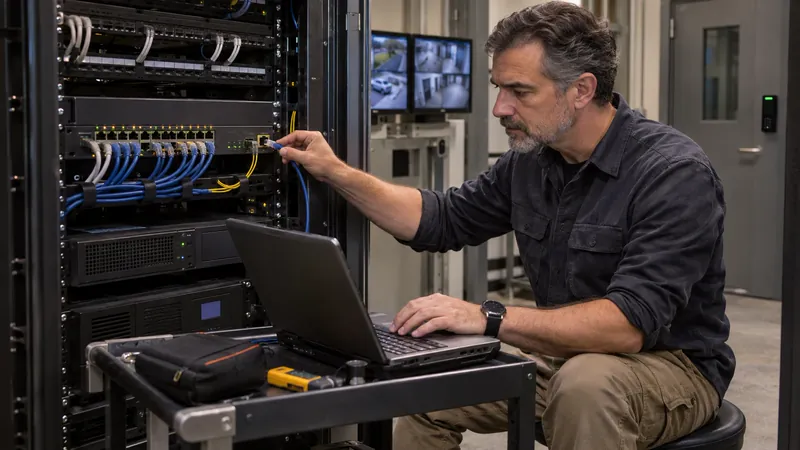
After that, it makes sense to:
- Check the full firmware version. Patch 2 is not enough; the affected models need Patch 3.
- Download firmware only from the vendor's official source, always the file that belongs to the exact model.
- Back up the configuration. The backup must be protected too, because it may contain network addresses, VLAN settings and credentials.
- Plan a maintenance window. With a PoE switch, expect cameras to restart and recording to drop out temporarily.
- Verify after the update. Check not only the active firmware but also the configuration, VLANs, ports, PoE status and uplinks.
- Look for signs of compromise. If the device ran vulnerable firmware with a management interface reachable from a wider network, review the logs, configuration changes and the indicators of compromise published by researchers.
- Change credentials where needed. If compromise is suspected, updating alone is not enough: a verified rebuild of the configuration, new administrator passwords and a review of related access may be justified.
The management interface needs its own protection
A firmware update is only one layer of defence. The switch's management interface should not be reachable from the general user network, nor from the segment of the cameras or other security endpoints.
A sound design uses a separate management VLAN, restricted administrator access and a logged entry point: the web or SSH interface should only be reachable from designated workstations or through a protected jump host. Do not publish remote management directly to the internet; if it is needed, build it on a controlled VPN with multi-factor authentication.
Removing default passwords matters too: in this campaign, more than half of the breached switches still had factory credentials. Disabling unused services, keeping administrator accounts few and documenting changes also count. Why can responsibility for the network and for physical protection not be separated? That is the subject of The convergence of cyber and physical security.
Updating is a process, not a one-off event
The Zyxel case shows that "the latest firmware is installed" is not a complete security guarantee: CISA urged updating in September, but the June firmware did not fix the flaw the attackers were using. Updating remains a basic requirement; the lesson is that it needs further controls alongside it. I wrote about where the time to patch can be shortened in Faster cyber attacks in the age of AI.
A proper operating process includes at least:
- an up-to-date inventory of devices and firmware;
- regular monitoring and risk-based assessment of vendor security advisories;
- a tested update and rollback procedure;
- a separate management network, configuration backups and change management;
- device health and network monitoring;
- planned replacement of devices that are no longer supported.
The switch is not just an IT accessory but a basic infrastructure element of physical protection, so it belongs in the risk assessment just as much as the camera, the recorder, the access control panel or the alarm transmitter.
Asking whether the network works is not enough
When a security network is handed over or periodically reviewed, it is not enough to check that the camera can reach the server.
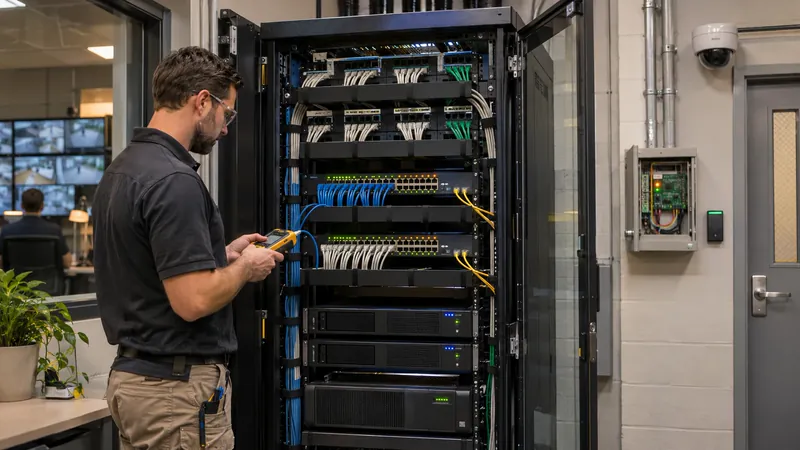
A system that works is not necessarily a secure system. Every camera may show an image, every door may open and every link may be stable, while a serious vulnerability waits to be exploited on a management interface.
The key lesson
The Zyxel GS1900 case does not prove that firmware updates are pointless. Quite the opposite: affected systems now need to be updated to Patch 3. The real lesson is that a patched device cannot automatically be considered protected against every known and unknown attack.
Security does not come from a single firmware version but from several measures that reinforce each other: updates, network segmentation, management protection, logging, device inventory, access control and regular checks.
In my experience, Zyxel switches are so widely used in Hungarian security installations that this case has to be taken especially seriously. The question is not only whether an affected switch exists somewhere, but whether we know exactly where it runs, which firmware it has, what is connected to it, and what protection would be lost if it were compromised.
Sources: Help Net Security (5 November 2026) · Zyxel: CVE-2026-107441 (3 November 2026) · Zyxel: CVE-2026-7273 and Patch 2 (16 June 2026) · Binarly: technical analysis (3 November 2026) · Help Net Security: the attack campaign (22 September 2026)
Last reviewed:
Questions, or an idea to talk through?
Whether it is a security system, the IT network behind it or just a thought on this article, I am happy to hear from you.
Get in touch