From garden shed to meadow: glowworms glow again at Nosterfield after a century
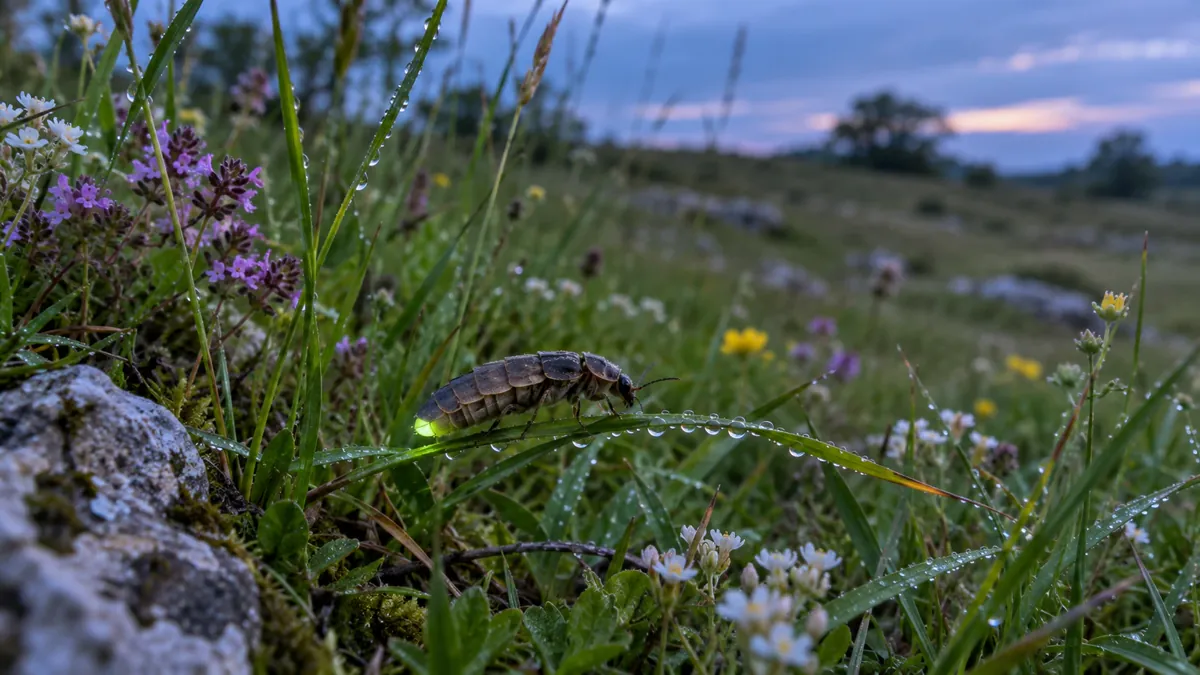
There is something especially reassuring about good news that comes not from a billion-pound programme but from a garden shed. In the summer of 2026, small greenish lights appeared in the grass again at Nosterfield Nature Reserve in North Yorkshire, in the north of England: glowworms were shining where nobody had seen one for about a hundred years. A Good News Network article from November 9, based on a September report in The Guardian, tells how a quiet, volunteer-run project got this far. Good News Network, November 9, 2026
The main character is Pete Cooper, who collects and breeds glowworms in his spare time, without payment. He rears the larvae in a garden shed and only then releases them. There is no big research institute or government programme behind it, just persistence, patience and an awful lot of snails.
What exactly is a glowworm?
Let us start with a small surprise: a glowworm is not a worm but a beetle. The species most often seen in the UK is the common glowworm (Lampyris noctiluca), a member of the firefly family. According to the Natural History Museum in London, the adult female is wingless, her body resembles a larva, and she is about two centimetres long. The males are much smaller and can fly. Natural History Museum – the glimmering world of glow-worms
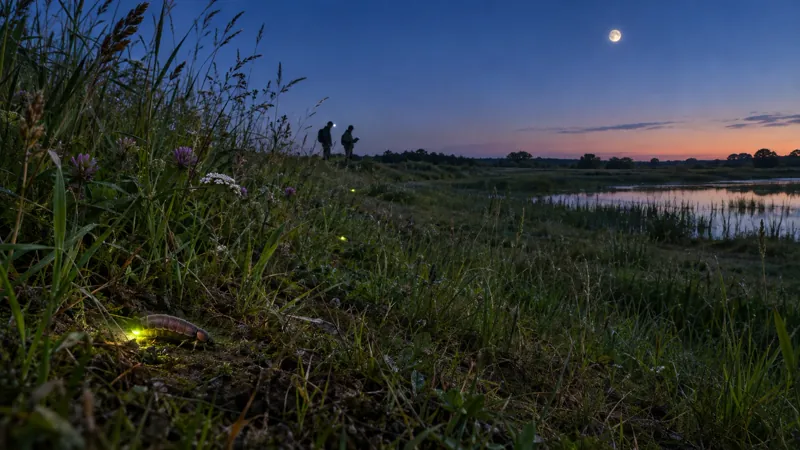
The light comes from the female. On summer evenings she climbs a grass stem and turns the light organ at the tip of her abdomen upwards so that males flying overhead can see her. During the day she burrows into the ground. The glow is the result of a chemical reaction: a substance called luciferin combines with oxygen, driven by the enzyme luciferase. Because the beetle cannot easily control its oxygen supply, it does not flash like some of its relatives; it glows steadily and calmly instead.
Adult glowworms do not even eat, and the female lives for only a few weeks, until she has mated and laid her eggs. The real work is left to the larvae, which hunt small snails. According to the UK Glow Worm Survey, a larva appears to paralyse a snail and then suck it dry; large garden snails are not suitable prey. The larvae stay larvae for one or two further summers before becoming adults. UK Glow Worm Survey
So when you spot a green dot of light in the grass on a summer night, you are really looking at the short, bright finale of a life cycle that takes several years.
Why did they disappear?
Glowworms were once common across Britain, but they have vanished from many places, and once they are gone they are very hard to bring back. The Natural History Museum mentions two studies. Research from 2014 found that even very low levels of artificial light disrupt males searching for a mate. A study from 2020, covering 18 years, found that the number of glowing females at monitored sites in south-east England fell by about 3.5 per cent a year.
Light pollution is therefore an important factor: a female can glow all she likes if the male is heading for a street lamp instead. But it is not the only one. According to reports summarising the Guardian article, Pete Cooper also lists intensive farming, development, artificial lighting and the loss of varied, slightly untidy grassland among the causes. At Nosterfield, quarrying also played a part in putting the lights out. Infobae / KCH Comunicación (in Spanish)
That may sound familiar: a very tidy environment that stays lit all night looks neat to us, but it is no home for a tiny larva hunting snails.
A garden shed as a nursery
According to the reports, Pete Cooper is an independent ecologist who has been working on the project for six years. Under licence he collected a few adults from a surviving population, then reared hundreds of larvae in his garden shed, which the reports place in Bristol. Snails are the main food here too, so running the nursery takes a good deal of care.
Volunteers help with the work. Good News Network playfully calls the people who have built up real expertise in rearing larvae in captivity “glow-getters”. This year, volunteers from the Westbury Wildlife Park Foundation helped raise another 1,900 larvae, to be released at Nosterfield during 2026. Part of the cost of the expanded breeding facilities was raised through ceilidhs, traditional Scottish and Irish dance evenings.
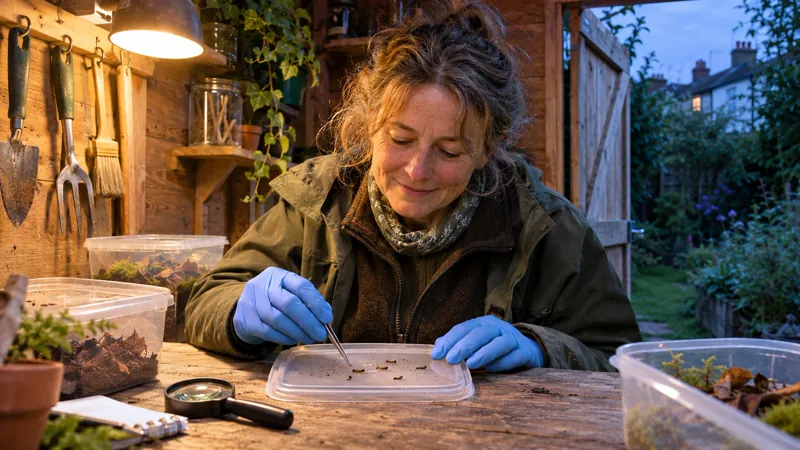
There is something very lovable about this. It did not take cutting-edge technology, just a shed, a few plastic tubs, a magnifying glass, lots of snails, and people willing to do the same patient work evening after evening.
Light at Nosterfield again after a century
Nosterfield is a good place for an experiment like this. According to Good News Network, the reserve of about 600 acres grew up on old limestone quarries: some parts recovered naturally, while others were rewilded into habitat by a nonprofit, the Lower Ure Conservation Trust. It is regarded as one of North Yorkshire’s most important wetland wildlife sites. According to the reports, the trust bought its first 29 hectares of disused quarry in 1997. Today wet meadows and grassland alternate across the site, which is also home to bitterns and marsh harriers.
The limestone is good news in itself. The Natural History Museum notes that glowworms are often associated with limestone areas, because that is where plenty of small snails live, the larvae’s favourite prey.
The site’s history fits the story nicely, too. The writer Edmund Bogg recorded large numbers of glowworms here in 1909 and compared their light to lamps lit by fairy folk. Then came quarrying, and the lights went out for about a century.
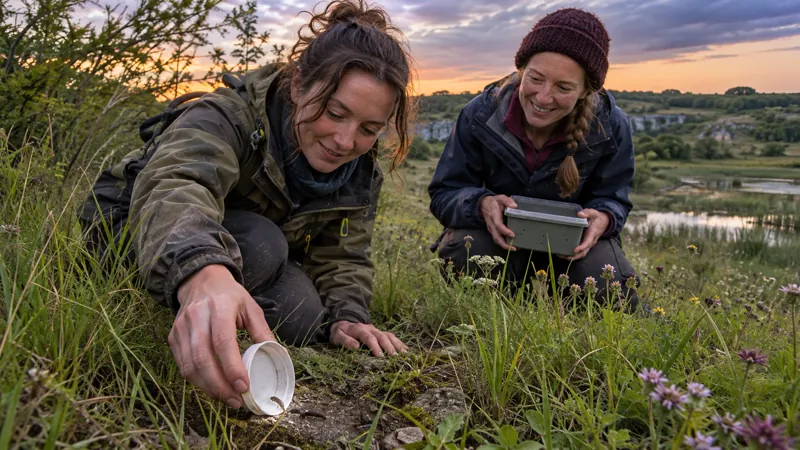
The first shed-reared larvae were released onto the grassland in 2024. Because it takes about two years to reach adulthood, the visible result had to wait until this summer. And then it came: over consecutive weeks, volunteers counted up to twelve glowing females on a single evening. Simon Warwick, manager of the reserve, told the Guardian that the species is incredibly rare in the region and that he could hardly describe how excited the volunteers had been.
A patient game until 2030
Twelve points of light on a summer evening sounds wonderful, but Cooper is cautious. According to the reports, the population can only be called self-sustaining once the offspring of this year’s wild adults have also grown up and started to glow. That should happen around 2030 at the earliest.
This is one of the most honest sentences in nature conservation. Releasing animals is easier than keeping them. A reintroduction is truly successful when the species no longer depends on supplies from a shed, and the meadow itself can sustain it: enough snails, enough darkness and enough undisturbed grassland for females to find a mate and for larvae to grow up.
The British survey also points out a practical detail. Because two or three years pass between generations, a site can be busy one year and look almost empty the next. A weaker summer is therefore not a failure, which is why counting has to continue patiently for several years.
What can a shed teach us?
The Good News Network summary ends on a lovely thought: breakthroughs do not always come from billion-pound programmes; sometimes a single dedicated person and a garden workshop are enough. I would add that Cooper did not work alone either. It took licences, a habitat restoration charity with eighty volunteers, and helpers from a wildlife park.
It is the same pattern we saw in Karl Bushby’s 28-year journey: persistence is rarely a solitary heroic act. It is much more a series of well-chosen small steps, carried forward by the support of others.
And there is a third lesson: good news takes time. Two years for the larvae, at least six for the whole effort, before we know whether the population will stay. In a world where we measure everything instantly, it is refreshing to follow a story whose success can only be declared years from now.
If you would like to see them yourself
Glowworms live in many parts of Europe, so you may not have to travel far to see one. The British survey’s advice is useful anywhere:
- Watch for midsummer: according to the Natural History Museum, adults in Britain are most active in June and July.
- Leave them where they are, and do not take any home, not even a female you think is about to lay eggs.
- A brief look by torchlight is enough; very bright light spoils your night vision and can distract the males.
- Stay on paths, and if you are in a group, walk in single file so you do not trample the grass.
And the simplest help of all: wherever possible, switch off unnecessary garden and outdoor lights. A glowworm does not need much: a little darkness, a few weeds and some snails.
Sources: Good News Network, November 9, 2026 · Infobae / KCH Comunicación (in Spanish) · Natural History Museum – the glimmering world of glow-worms · UK Glow Worm Survey
Last reviewed:
Questions, or an idea to talk through?
Whether it is a security system, the IT network behind it or just a thought on this article, I am happy to hear from you.
Get in touch