
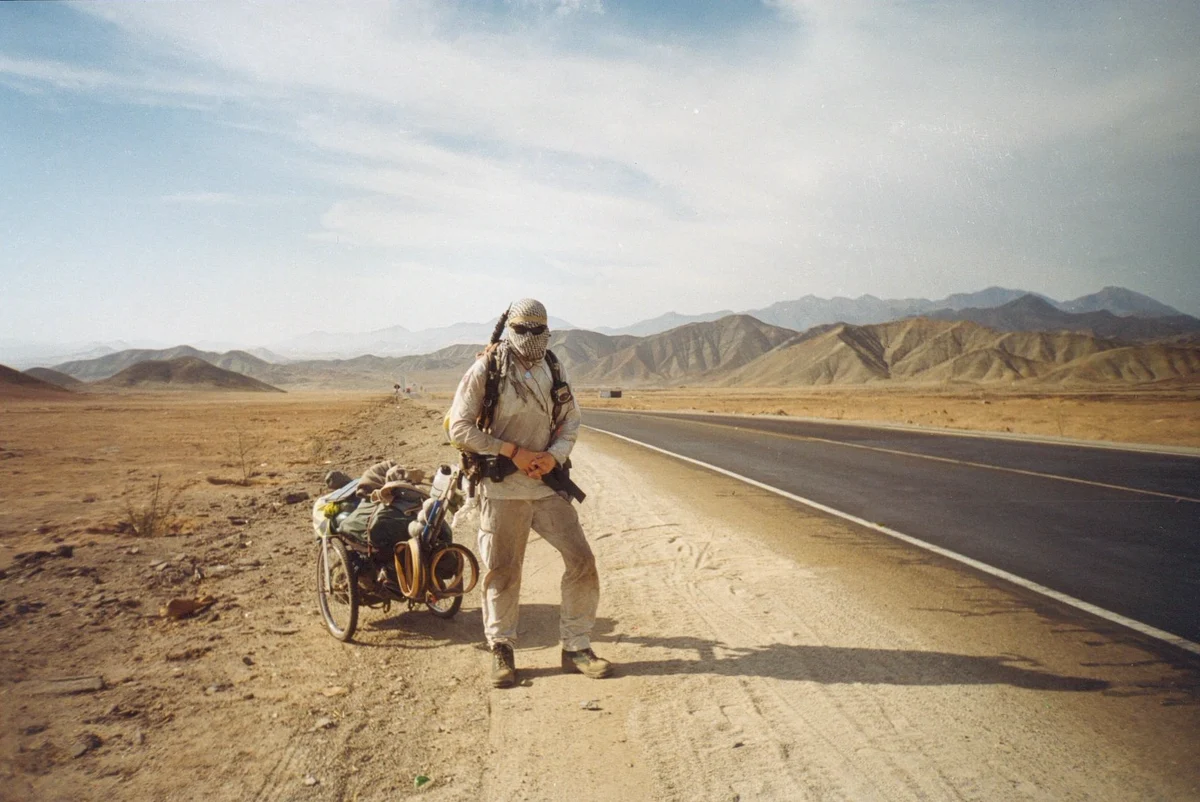
28 years and 50,000 kilometres: the real lesson of Karl Bushby’s homecoming
On November 1, 1998, Karl Bushby set off from Punta Arenas in southern Chile. His goal was both simple and almost unimaginable: to reach his home in Hull, England, without using a vehicle to advance along the route, and to return home only after completing the journey.
Twenty-eight years later, on November 2, 2026, he arrived at his mother’s house. According to the Associated Press, the journey covered roughly 50,000 kilometres across four continents and thirty countries. The Goliath Expedition was more than a long walk: it was a project repeatedly reshaped by reality while its fundamental goal stayed the same. Associated Press – homecoming, November 2, 2026
A goal is not the same as a plan
Bushby set himself two rules: he could not use transport to move forward along his route, and he could not return home until he reached it on foot. Those rules defined the expedition, but they did not make every detail predictable.
Originally expected to take around twelve years, the journey lasted almost three decades. Progress depended on more than terrain and physical effort: funding difficulties, closed borders, visa problems, the 2008 financial crisis and the COVID-19 pandemic also intervened. Associated Press – background report before the finish
This is one of the expedition’s strongest lessons: a major goal needs a steady direction, but the plan for achieving it must remain flexible.
An overly rigid plan falls apart at the first unexpected obstacle. Flexibility without a goal can turn into drift. Bushby’s story held both elements together: the destination remained the same, while the way of reaching it kept adapting to circumstances.
Persistence is more than prolonged effort
We often imagine persistence as unwavering willpower: someone makes a decision once, then moves forward with the same energy every day. In practice, sustained achievement is much more a sequence of decisions.
When should you stop? When should you look for another sponsor? When should you choose a different route? When should you accept that the original estimate no longer applies? And when should you hold on to what really matters?
Bushby’s own website describes principles that remained constant even as circumstances forced changes to the route and method. He crossed the Caspian Sea as part of an organised swimming expedition rather than by vehicle, and returned to the United Kingdom by swimming the English Channel in October 2026. Karl Bushby – The Goliath Expedition
The lesson is not that every goal must be achieved at any cost. It is that long projects require us to distinguish the mission from the initial method. The goal can remain constant while the solutions used to reach it evolve.
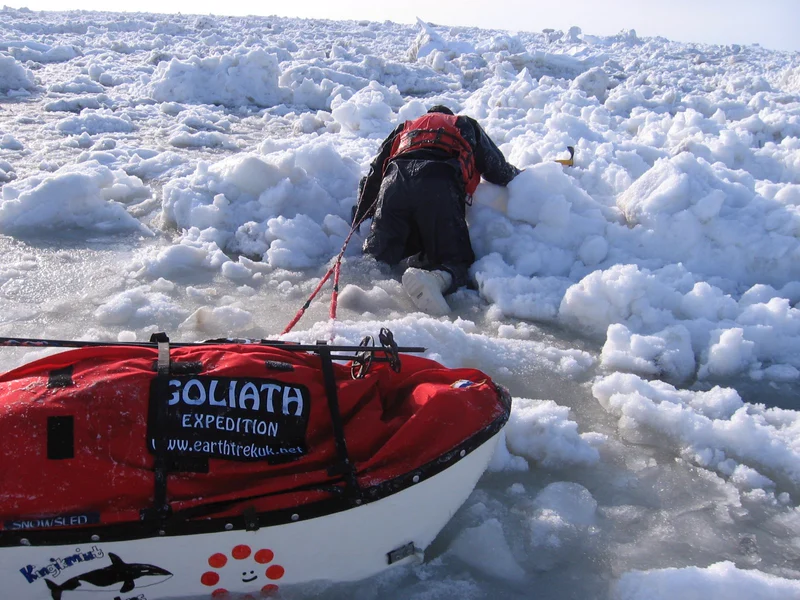
A system supported the physical achievement
The distance of 50,000 kilometres is striking, but it does not explain the achievement on its own. An undertaking of this scale is not a continuous heroic act. It is a system of small, repeated tasks: equipment, food, rest, route planning, weather, administration, communication, health and support.
Long-term performance does not depend on doing something extraordinary every day. It depends more on maintaining everyday operations over a long period.
This perspective is familiar in engineering, security systems and operations. Small problems left unresolved can undermine a system: a missed inspection, no backup plan, incomplete documentation, or nobody taking responsibility for the next decision.
Bushby’s journey is a reminder that reliability is not the result of a single great effort. Reliability is a process.
Individual achievement also depends on a community
The Goliath Expedition can easily be read as a solitary feat, but Bushby’s own account emphasises the role of supporters, local helpers, family members, specialists and organisations. One person kept the goal in sight, but he did not solve every problem alone. Karl Bushby – The Goliath Expedition
This corrects the idea that persistence is an exclusively individual quality. Long, complex tasks need independence, but they also need the ability to ask for help, build partnerships and trust other people.
A reliable security system does not depend solely on one excellent camera, access controller or alarm panel. Technology, operators, maintenance, procedures and decision-making responsibility have to work together. In an expedition, the same idea takes another form: equipment, logistics, human relationships, local knowledge and adaptability make up a shared system.
Slow progress is still progress
Much of modern life revolves around speed: short project cycles, immediate results, rapid growth and constant optimisation. Bushby’s story offers a counterpoint.
The journey included long periods of waiting and interruption, yet the goal remained. It took twenty-eight years because reality did not follow the initial estimate. The project’s duration could not be fully controlled; the next manageable step still mattered.
This distinction applies to many situations. Professional development, a business, an engineering project or a personal goal often takes longer than we first expect. Delay does not automatically mean failure. The more useful questions are whether the goal still makes sense and whether the next step still moves us forward.
Coming home is a task too
Bushby’s homecoming completed the physical expedition, but finishing a long mission is a change in its own right. In an Associated Press report before the finish, he spoke about the difficulty of readjusting to a world that had changed considerably since his departure. Associated Press – background report before the finish
This may be the most human part of the story. Departures and arrivals attract attention, while the question of what happens afterwards receives less. Completing a major project brings more than success. It creates a new situation: a different rhythm, a different role and new decisions.
Karl Bushby’s story is therefore about more than walking. It explores how a person can hold on to a goal for years while the world, the circumstances and the person themselves change.
Fifty thousand kilometres is impressive. Twenty-eight years is even more so. Perhaps the most important lesson is that Bushby reached home because, whenever events diverged from the plan, he found the next step he could reasonably take.

Sources: Associated Press – homecoming, November 2, 2026 · Associated Press – background report before the finish · Karl Bushby – The Goliath Expedition · The Hull Story – the expedition and archive photographs
Last reviewed:
Questions, or an idea to talk through?
Whether it is a security system, the IT network behind it or just a thought on this article, I am happy to hear from you.
Get in touch