Radar is not a camera — and that is exactly why perimeters need it
When defending expansive outdoor perimeters – such as freight logistics yards, manufacturing depots, utility-scale solar farms, or airport aprons – relying solely on optical surveillance cameras is almost invariably an engineering compromise. Even with multi-megapixel sensor resolution, optimized focal lengths, and infrared illuminators, control room operators and video content analytics (VCA) engines are tasked with extracting genuine physical threats from millions of fluctuating pixels.
Under real-world conditions, swaying foliage, spiders nesting across domes, heavy precipitation, dense fog, and headlight glare trigger an exhausting torrent of nuisance alarms. Furthermore, even cameras covering wide fields of view struggle to deliver dependable, immediate verification of whether an intrusion has actually taken place at range or if an animal merely disturbed the grass.
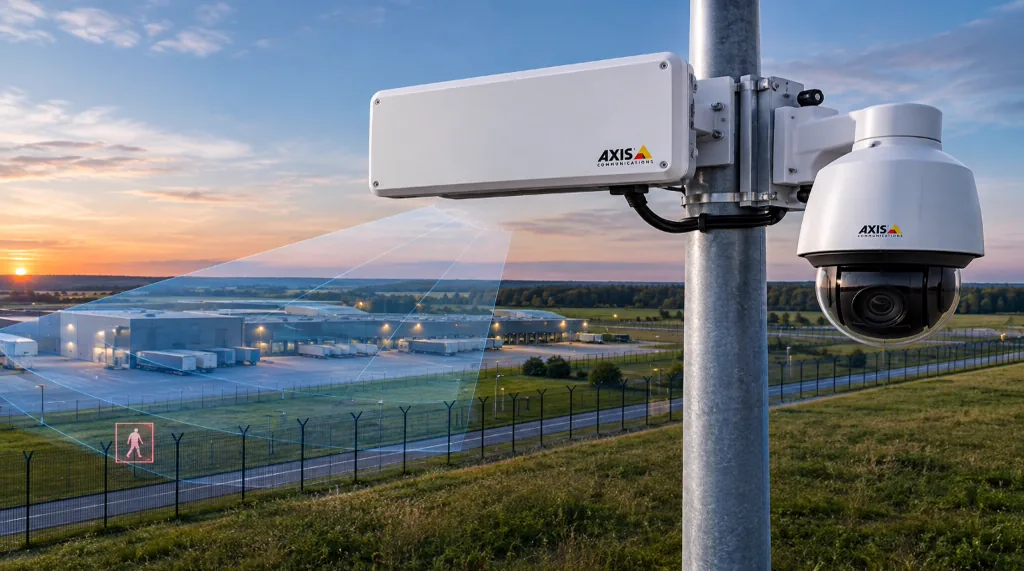
This operational challenge is precisely where microwave security radar excels. Axis Communications introduced the AXIS D2124-VE, a 360-degree network security radar engineered for wide-area perimeter protection, highlighted in technical reports by Euro-Security and on Axis Communications’ product platform. According to manufacturer specifications, the radar provides human detection and tracking coverage across zones up to 40,000 square meters (approx. 430,000 sq ft), tracks motor vehicles up to 200 meters away, and pairs directly with PTZ cameras to deliver automated visual verification.
Division of labor: detection vs. visual interpretation
In a resilient physical security architecture, radar and video surveillance serve distinct, complementary operational functions. Treating radar as a „replacement” for cameras is an engineering misconception; rather, their underlying physics make them formidable partners:
- Radar excels at spatial detection and kinematic tracking: Operating on Frequency Modulated Continuous Wave (FMCW) radio principles, security radar emits microwave pulses and measures Doppler frequency shifts, phase delays, and signal reflections. It computes a target’s precise range, azimuth angle, and radial velocity vector with sub-meter accuracy. Radar is completely impervious to pitch-black darkness, solar glare, headlights, smoke, and thick fog. However, radar produces zero optical details: it cannot reveal clothing, license plates, facial features, or whether a subject holds a bolt cutter or an umbrella.
- Cameras deliver visual context and threat classification: Optical sensors capture ambient or active illumination to render high-contrast imagery, allowing human eyes and convolutional neural networks to interpret context. Cameras answer the decisive operational question: what is happening, and who is doing it? Conversely, cameras suffer from narrow depth perception and severe vulnerability to weather and low contrast.
This functional segregation is the cornerstone of effective perimeter security: radar rapidly indicates across broad acreage where and how fast something is moving, while the camera reveals what that object actually is.
PTZ autotracking and „double-knock” verification logic
The true power of radar detection is unlocked through coordinate-based integration with Pan-Tilt-Zoom (PTZ) dome cameras. Within the Axis architecture, target coordinates detected by the radar trigger the AXIS Radar Autotracking for PTZ engine.
The moment an intruder enters a monitored radar zone, spatial coordinates $(x,y)$ and velocity vectors are fed in real time to the paired camera (such as a high-speed AXIS Q6225-LE PTZ). Within milliseconds, the camera slews, tilts, and zooms directly onto the target, initiating smooth visual tracking. Security control room operators are not forced to hunt for suspects with joysticks in the dark; the magnified, focused live feed of the intruder appears automatically on their video wall.
Equally crucial is the „double-knock” verification logic documented in Axis’s technical manual. Under this operational rule, an event triggers an audible deterrent, strobe lights, or central monitoring dispatch only when both sensing modalities independently validate the intrusion: the radar detects physical motion across the spatial coordinate, and optical video analytics (or thermal sensing) confirms a human classification. This sensor fusion dramatically mitigates nuisance alarms caused by wind gusts, blowing trash, or passing birds.
What datasheets omit: topography, radar shadows, and physical reflections
A datasheet metric boasting 40,000 square meters of coverage is an inspiring figure, but rigorous systems engineering demands accounting for the physical realities of RF wave propagation:
- Radar Shadows (Line-of-Sight Blockage): Microwave signals propagate in straight paths and cannot penetrate dense solid structures. Parked shipping containers, semi-trailers, temporary warehouse pallets, concrete retaining walls, and dense hedgerows create blind radar shadow zones behind them. If site surveys fail to account for operational storage patterns – a vulnerability examined in Good system design does not begin on the floor plan – intruders can exploit blind corridors with impunity.
- Ghost Targets and Multipath Reflections: Substantial metallic surfaces – such as corrugated metal warehouse walls, chain-link fences, and steel storage tanks – act as specular reflectors for microwave frequencies. Bounced radio signals can generate virtual „ghost” targets on radar displays where no physical entity exists.
- Ground Surface Characteristics: Radar performs most reliably over uniform, hard planar surfaces like asphalt and compacted concrete. Loose gravel, coarse crushed stone, and wet, uncut grass scatter and absorb low-grazing microwave beams, which can diminish sensitivity against low-profile crawling intruders.
- Mounting Stability and Structural Vibrations: High perimeter poles buffet and sway under gale-force winds. Unmitigated physical pole sway causes the radar antenna to displace, which internal algorithms can misread as environmental target motion. Secure structural mounting and active Radar Image Stabilization are non-negotiable requirements.
Zone engineering: preserving operator cognitive bandwidth
The objective of security radar is never to sound an alarm for every fluttering leaf. The objective is to command operator vigilance only when intervention is genuinely justified.
The AXIS D2124-VE utilizes rectangular, box-shaped detection zones, enabling system designers to contour coverage tightly along property boundaries, building perimeters, and internal access corridors rather than awkward circular arcs. System configuration must differentiate between:
- Inclusion Zones: High-security internal perimeters where any verified human or vehicular presence immediately activates PTZ tracking and priority dispatch.
- Exclusion Zones: Public roads, adjacent rail lines, or swaying tree canopies lying within radar range that are masked out in software to suppress external traffic noise.
- Directional and Velocity Filtering: Rules configured to alert exclusively on trajectories heading inward toward critical assets, ignoring vehicles departing along approved exit lanes.
Across extensive commercial facilities, the scarcest resource is never hard drive storage; it is the cognitive bandwidth of human operators. When radar filters out ambient environmental noise and delivers focused visual evidence, the surveillance architecture transitions from passive video watching to intelligent, exception-based protection.
Engineering conclusions for perimeter design
A well-engineered perimeter security ecosystem does not make the impossible promise that false indications will never occur. It promises that the system will rapidly, deterministically, and intelligibly separate real threats from environmental clutter.
The decisive metric in perimeter security engineering is never how many square meters look impressive on a marketing brochure. It is whether, during a genuine nighttime intrusion, the system delivers verified, actionable intelligence fast enough for responders to make the right operational decision.
Questions, or an idea to talk through?
Whether it is a security system, the IT network behind it or just a thought on this article, I am happy to hear from you.
Get in touch