Good system design does not begin on the floor plan
On a security engineering blueprint or architectural floor plan, everything looks remarkably neat and orderly. CAD layers separate cleanly, camera field-of-view cones form crisp geometric wedges across hallways, card readers and magnetic door contacts sit beside door symbols, central rack enclosures anticipate calculated terabytes of video storage, and cable pathways display millimeter-precise run lengths.
Yet the most critical engineering details of a security system are almost never born on the floor plan.
They live in the informal, seemingly casual remarks voiced during a physical walk-through. “This gate is only used at 5 AM by sanitation trucks.” “You cannot drill or mount conduit along this wall because it is a heritage-listed plaster facade.” “The reception desk guard loses all line of sight to the vehicle barrier the moment they stand up from their workstation.” “Don’t bother putting a card reader on that delivery door; couriers will prop it open with a fire extinguisher during the morning rush anyway.”
It is from these subtle, operational and physical nuances that a successful installation is forged – or from their omission, that project delays, costly variations, scope disputes and post-commissioning friction arise.
Digital site survey platform developer System Surveyor announced the General Availability of its AI Notetaker on October 1, 2026, as reported by Security Systems News. The tool specifically targets this fragile, early-stage project dialogue: capturing conversations during walkthroughs, extracting requirements and site observations, and associating them directly with digital floor plan pins in real time.
The most expensive mistake is an unrecorded remark
During a physical walkthrough, the client, the facility manager, and the security systems integrator rarely communicate in a shared technical vocabulary. The client does not speak in relay logic, Wiegand or OSDP protocols, or pixels-per-meter DORI densities. They speak of daily operational friction, staff workarounds, and past security headaches.
A logistics warehouse manager rarely says, “I require DORI-standard identification quality in Zone 4 paired with smart line-crossing analytics.” Instead, while standing beside the loading dock, they remark: “Come November, when holiday freight ramps up, we stack pallets up to the ceiling in this buffer aisle, and forklifts routinely clip that corner pillar.” If the survey engineer fails to capture that comment, the camera gets routinely designed onto that very pillar. By November, the field of view is completely blinded by a mountain of corrugated cardboard, and a forklift knocks the camera off its bracket during the first night shift.
Similarly, an office building property manager will not discuss credential partition granularity. They will say: “Cleaning crews always exit through the courtyard emergency door after 10 PM because the main lobby turnstiles are locked down, but the alarm keeps dispatching police patrol units.” If the designer relies strictly on the architectural floor plan symbol, they specify a standard panic exit device with a simple door contact. The outcome? Ten false alarm dispatches per week, operational frustration, and contentious relationships with local law enforcement.
Poorly documented walkthrough information does not reveal its cost on the day of the survey. It reveals its cost months later: when the installation crew discovers a 20 kV high-voltage conduit hidden behind the drywall they were instructed to core-drill, when a badge reader position conflicts with actual pedestrian egress flow, or when an HVAC duct completely blocks a camera mount.
System Surveyor AI Notetaker: turning walks into living documentation
For decades, the survey process looked nearly identical across the industry: a folded paper blueprint clipped to a board, a ballpoint pen, a handheld laser measure, and dozens of smartphone photos. Back at the office, the systems engineer faced the grueling task of deciphering which of the 140 ceiling photos corresponded to Door 12 and what a hastily scribbled scribble meant next to a stairwell.
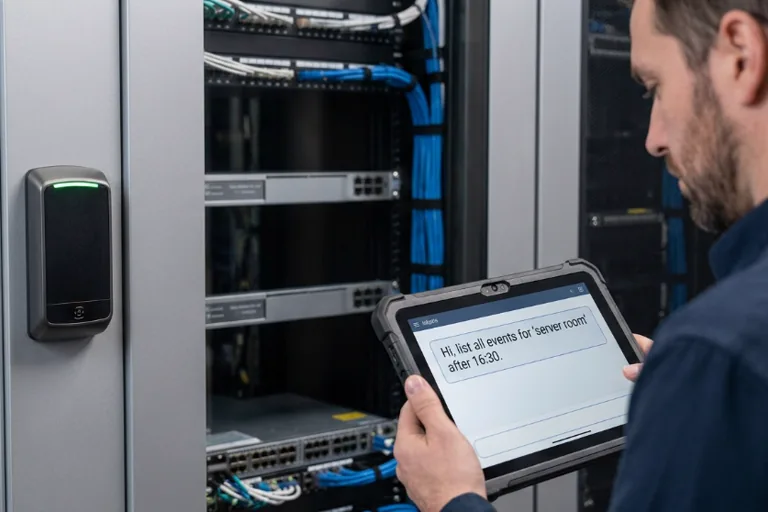
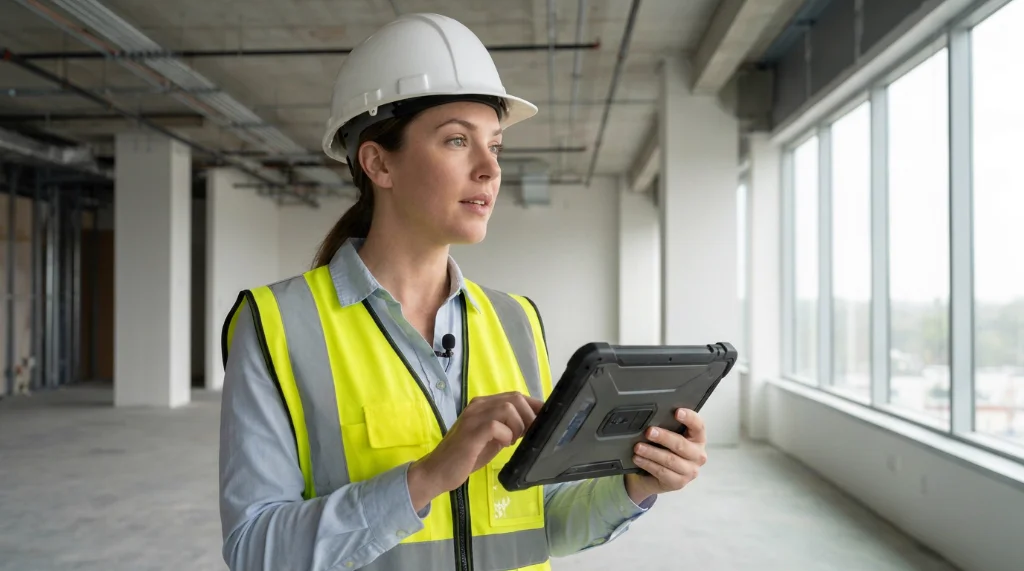
System Surveyor’s cloud platform previously replaced paper by letting integrators pin security devices directly onto digital plans on tablets. The October release of AI Notetaker augments that mobile workflow with hands-free audio intelligence. As the engineer walks the facility with the client, a wearable microphone or rugged tablet listens to the conversation in the background.
The breakthrough lies not in raw transcription – generic voice recorders have done that for years – but in automated contextualization:
- Spatially anchored observations: Spoken requirements are bound directly to the active floor plan element, camera position, or access-controlled opening.
- Separating operational needs from physical constraints: The language model categorizes conversational remarks into operational intent (who needs access and when) versus structural obstacles (no existing cable raceway, plenum ceilings, or lack of clean power).
- Drafting SOW and bill of materials (BOM): Upon concluding the survey, the team is not left with hours of unorganized audio, but a structured first draft of a Statement of Work, initial device counts, and preliminary installation scopes ready for engineering review.
This bridges the notorious “black hole” between Friday’s field walkthrough and Tuesday morning’s CAD design, where critical nuances traditionally vanished.
Where AI excels on a site survey – and where the boundary lies
Whenever artificial intelligence is introduced into an engineering workflow, an essential question arises: is the software replacing the engineer? As I explored in AI as an analyst, not a door-opening controller regarding cloud access control, AI delivers its highest value in analysis and preparation, not autonomous physical command.
On a site survey, an intelligent assistant excels at compensating for the natural bottlenecks of human attention:
- Searchable project memory: When a general contractor or project manager asks six months later why a narrow-angle bullet camera was specified at the loading bay instead of a wide-angle dome, no one has to rely on faded memory. A quick search of the survey transcript reveals the answer: the client specifically pointed out that sodium-vapor yard lighting causes blinding glare and dome bubble reflections at that angle.
- Categorizing operational reality versus technical specs: AI accurately groups notes by trade – separating IT network demands from facility management preferences and physical security hardware requirements.
- Immediate on-site alignment: A structured summary can be reviewed with the client in the parking lot right after the walkthrough, confirming agreed scopes before anyone leaves the facility.
However, an engineer must recognize the firm boundary: a structured narrative summary is not a design document. It does not calculate PoE budgets, bandwidth consumption, storage retention, or life-safety egress compliance.
What no software algorithm can automate
Regardless of how capable large language models become, software cannot navigate physical laws, optical physics, or local building codes on its own. There are three core engineering domains where software remains blind and hands-on professional expertise is irreplaceable:
- Optical physics and lighting dynamics: On a CAD screen, a camera field of view is a clean, uniform green wedge. In physical reality, low-angle winter sunlight creates severe backlighting, delivery truck headlights temporarily blind sensors, and modern glass facades introduce intense specular reflections. As detailed in my analysis of video evidence from camera to courtroom, achieving true identification under the EN 62676-4 DORI standard is a matter of lux levels, shutter speeds, and sensor geometry – not theoretical pixel math.
- RF propagation and cabling realities: Digital floor plans show walls, but they do not reveal whether drywall conceals structural steel columns, elevator shaft shielding, or heavy electromagnetic interference from machinery. Wireless locks and sensors require physical RF signal testing. Similarly, verifying structural 90-meter copper cabling permanent link limits, voltage drops on 12/24 VDC lock circuits, and existing firestop penetration capacity cannot be prompted into existence.
- Life safety, egress codes, and legal liability: Access control on emergency exit routes is governed by stringent life-safety codes (such as NFPA 101, IBC, and European EN 179 / EN 1125 standards). Fail-safe versus fail-secure hardware operation, fire alarm system relay drops (fire release), and delayed-egress timings carry severe life-safety and legal liability. No software developer assumes criminal responsibility for an emergency door failing to release during an evacuation. That responsibility rests solely on the licensed engineer.
The true stakes of a survey: preserving shared engineering intent
Building a physical security system is a multi-stage relay race. It moves from the survey engineer to the estimator, the lead design engineer, the project manager, the electrical cabling subcontractor, the commissioning technician, and finally the facility operator who maintains it for a decade.
Project failures, cost overruns, and security compromises almost always occur at the handoff points – where the nuanced operational context gathered during the survey fails to reach the next person in line.
The true benchmark of a successful site survey is not generating a twenty-page transcript on a tablet. It is ensuring that four months later, the technician standing on a ladder in an unfinished building understands exactly why a radar sensor must be mounted at 2.6 meters with a 15-degree downward tilt, and why the camera cable must route around an air duct rather than through a structural beam.
Good system design does not begin when CAD software opens on a desktop.
It begins when the raw spoken reality of a physical site is transformed into verified, durable, and actionable engineering knowledge.
Sources: System Surveyor – System Surveyor Announces General Availability of AI Notetaker to Streamline Site Surveys and Automate System Design (October 1, 2026); Security Systems News – System Surveyor launches AI Notetaker for site surveys, system design (October 2026)
Questions, or an idea to talk through?
Whether it is a security system, the IT network behind it or just a thought on this article, I am happy to hear from you.
Get in touch